 Shakara Varatti is a special chips prepared in kerala. It is unique in taste and can be found in almost every Malayali household. This chips has the meaning and the description of its name in the name itself. Shakara varatti is a Malayalam word (language spoken by people of Kerala). Shakara means sweet and varatti means coated. Yeah right, this chips is sweet in taste and it is coated in jaggery which gives it this unique taste , hence it has this name.
 I have few malayali family friends and also i have few malayali friends while i was in college and i had a good opportunity to taste and explore their food and recipes. Kerala recipes are quite simple and not much complicated to prepare. Kerala being a coastal state , malayalis use things which are commonly and easily available in abundance over there. Being a coastal area, it is abundant in coconut trees, banana tree , rice , fish and ground vegetables. That being a reason, you can see many keralities using coconut and coconut oil for cooking. Coconut oil is believed to have many health benefits and beauty benefits. Well let me come to the recipe. Its a delicious recipe which almost tastes like a traditional candy. It requires less ingredients but needs good concentration of mind and little patience for preparing this recipe. But the secret of making any recipe delicious is just prepare with love and affection and serve it much love and affection even the worst made food would taste delicious.
So, here am posting the shakarra varatti recipe, i cant post the preparation pics though since most of the pics turned out to be blurred and had bad quality of light. But i will surely make it a point to prepare this once again when i get time and post the pics on this blog. As of now, I am elaborately explaining the method of preparing this recipe. This was the first time i prepared this, but am satisfied with the outcome so hope it would help those who read it too.
I have few malayali family friends and also i have few malayali friends while i was in college and i had a good opportunity to taste and explore their food and recipes. Kerala recipes are quite simple and not much complicated to prepare. Kerala being a coastal state , malayalis use things which are commonly and easily available in abundance over there. Being a coastal area, it is abundant in coconut trees, banana tree , rice , fish and ground vegetables. That being a reason, you can see many keralities using coconut and coconut oil for cooking. Coconut oil is believed to have many health benefits and beauty benefits. Well let me come to the recipe. Its a delicious recipe which almost tastes like a traditional candy. It requires less ingredients but needs good concentration of mind and little patience for preparing this recipe. But the secret of making any recipe delicious is just prepare with love and affection and serve it much love and affection even the worst made food would taste delicious.
So, here am posting the shakarra varatti recipe, i cant post the preparation pics though since most of the pics turned out to be blurred and had bad quality of light. But i will surely make it a point to prepare this once again when i get time and post the pics on this blog. As of now, I am elaborately explaining the method of preparing this recipe. This was the first time i prepared this, but am satisfied with the outcome so hope it would help those who read it too.
 Ingredients:
Unripe plantains(Raw Bananas) - 1 kg (it usually counts to 5 bananas)
Jaggery( - 300 gm
Cardamom( - 5 nos
Dry ginger and cumin seeds powder - 1 tbsp (add just 2-3 pinches of cumins to make powder)
Coconut oil - 250 gm
Ghee - 1 tbsp
Sour curd - 1/2 glass .
Method:
- Peel the skin of the plantains(Raw bananas).
- Slit the banana lengthwise and cut it into 1/4" pieces.
- Put them in warm water for few minutes , say some 10-15 mins.
- Take enough water to cover the plantain pieces.
- Pour sour curd into this water to get rid of the plantains’ serum. Usually raw plantains are sticky and this makes it uneasy to use . This white sticky thing which looks like serum makes the pieces cling to each other thus making it imperfect. Sour curd washes away those sticky serums thus giving you clean pieces of plantains for chip which stays seperated from each other.
- Keep this aside like this for some 30-40 mins. So that the sour curd removes away those sticky serums completely. It won't change the taste anyhow nor would the chips would taste sour.
- Now strain the excess water off.
- Now take a clean piece of cloth (water absorbale cloth) and pat dry the plantains. So that oil won't throw some boiling sparks on you while frying them.
- Heat oil in a deep bottomed vessel . Let it heat for sometime and then lower the flame as this would make the chips crisper.
- Put the plantains pieces in the oil . Put in batches so that it is fried nicely.
- Keep a check on them continuously by stirring in between so that it doesn't get sticked to each other.
- Cook in medium to low fire until the pieces start turning brown. Allow them to cook and fry them properly so that chips are crispy. It will take some time. (Here is a nice tip to know that the chips are fried. When the foams around the chips in hot oil are reduced, its a indication that its well friend and cooked but also be careful not the let them change the color to dark brown).
- Once the chips are fried remove the pieces from the oil using a strainer and put them in a tissue paper to absorb excess oil.
- Dissolve jaggery in water and bring this to a boil.
- When the boil settles down and the mixture becomes thick.
- Add the plantains into the boiling jaggery one by one .
- The consistency is right if you see thin jaggery threads forming while you stir the plantain pieces.
- Add powdered cardamom and dry ginger-cumin powder and mix well. So that the spices gets coated on each chip pieces.Also add ghee and mix well.
- Now the nicely coated coated jaggery pieces could be seen visibly seperated and turning dry. (In case, it doesn't look completely dry then add 2-3 tablespoons of fine sugar to this and stir well).
- Shakara varatti is ready. Allow it to cool down and then store them in a air-tight container. It remains for 1 month if stored properly.
Preparation Time: 1 hour and 30 minutes
Cooking Time: 1 hour
Shelflife: 1 -2 months if stored in air-tight container
Serves: Can be easily served to 20-15 persons
Serving Suggestions: Serve as a evening snack or serve it with lunch.
Note:
- Don't ever fry the chips directly in the oil. Do soak them in the sour curd for atleast 30 mins.
- For safety reasons especially beginners, do pat the chips in a dry clean cloth after removing from water and then fry them in oil so that boiling oil doesn't harm you.
- Keep stirring occasionally while frying, so that the chips doesn't stick to each other.
- When the foams around the chips in hot oil are reduced, its a indication that its well friend and cooked but also be careful not the let them change the color to dark brown.
- The jaggery is important part of this recipe. The consistency is right if you see thin jaggery threads forming while you stir the plantain pieces.
- In case, it doesn't look completely dry then add 2-3 tablespoons of fine sugar to this and stir well. This would let it dry and make perfect chips

Click here to know more about Kerala recipes and cuisines -
An Introduction to Kerala Recipes and Cuisines.
Click here to know more about Indian sweets and desserts -
An Introduction to Indian Sweets And Indian Desserts.

 Sheer Kurma is a traditional East Indian recipe and is always counted in Mughlai style of cuisines. This recipe is native to persia but it became a popular cuisine in India during the Moghul era. Sheer Kurma is served during Eid and is prepared otherwise mostly in winter seasons. This kind of dessert tastes best during winters and foodies bet on this words when it comes to this delicious dessert. Sheer kurma is a persian term , sheer means milk and kurma means dry date.This dish is served on the morning day of Eid in the family right after the morning prayers and is considered most important food of the eid festival. It is there after served to guests and relatives.This is a kind of dessert and can be served either cold or hot depending how a person wishes to have it. Vermicelli is easily available these days in market and that makes it easy to prepare it. Though the very names of Sheer kurma says its difficult to prepare, it isnt really hard to cook it. Any average or new beginner can try on this with good results. Just all that should be noted is few tips. Hope it pleases all.Ingredients:
Milk - 1 litre
Sugar - 1/2 cup
Almonds - 1/2 cup, blanched and skin removed sliced thin
Pistachios - 1/4 cup, blanched and skin removed sliced thin
Saffron - 1/4 teaspoon
Vermicelli - 1/2 cup, roasted and broken up (ready made roasted and broken vermicelli is available in market too)
Rose water - 1 teaspoon
Kewra essence - 4 drops
Raisins - 1/4 cup
Dry dates - 5-6 nos, soaked and chopped into 4 pieces .
Method:- Take a deep bottom vessel and pour milk in it.
- Bring the milk to boil on a medium heat.
- Once it boils, turn the flame to low and continue to heat it . Let it boil till it reduces to 2/3 quantity.
- Now add sugar and continue to boil till the sugar gets dissolved. It takes about 5 minutes.
- Keep stirring while the sugar gets dissolved to avoid the sugar from sticking the bottom of vessel.
- Add the raisins and dates when the sugar gets dissolved and cook it further for 5 minutes.
- Now add the vermicelli and cook for 3-4 minutes. Keep stirring often.
- Add the saffron (kesar) to it milk and stir well.
- Once the vermicelli softens , reduce the heat and cook it for 15 minutes more.
- Keep stirring often.
- Now turn off the heat and add the rose water and kewra essence.
- Keep it aside for some minutes.
- Garnish it with chopped and blanched almonds and pistachios.
- Serve hot or cold as per desire.
Preparation Time: 20 minutes
Cooking Time: 1 hour 20 minutes
Serves: 4 persons
Shelflife: 1 day
Serving Suggestion: Serve hot either hot or chilled after meals.
Note:
- Roast the vermicelli till it changes the colour. But dont ever over fry it.
- Reduce the milk to some quantity by heating it. U can measure it by the thickness of milk .
- You need not Reduce it to half the amount but just 2/3 of quantity.
- For blanching the almonds and pistachios, boil 2 cups of water and put the almonds and pistachios in it. Keep it inside the boil water for some 10 minutes. Then drain the water and removed the skin. You can then chop them thin into desired shapes .
- Kewra essence is available in market. It is used to add a aromatic touch to the cuisine. Rose water too does the same.
- Saffron is added to give the cuisine a good colour.
Click here to learn more about Uttarpradesh Foods and cuisines : An Introduction To Uttarpradesh Foods and Cuisines.
Click here to learn more about Indian sweets and Desserts: An Introduction To Indian Sweets And Desserts.
 A Modak is a sweet dumpling very popular in western and southern India. Modak has a special importance in the worship of the Hindu Elephant god, Ganesha. In India, Modak is considered to be the favourite food of God Ganesha, hence it is a age long ritual of making modak and offering them on the auspicious day of Ganesh Chaturthi. It is ritual of offering 11 or 21 modaks to the God Ganesha as "Naivedya".Ganesh Chaturthi is celebrated all over India, but it is celebrated with much enthuthiasm in Maharashtra where idols of Ganesha is brought home and the house and mandap( place where the idol is sitted) is decorated and people are invited to pray and take prasadhams. In Public places too large idols as long as 10 ft is sitted which is open to everyone irrespective of religion. The visarjan usually lasts as per people's preference . Some bid goodbye in 1 and half day, some for 5 days and some worship till the Ananth Chaturthi which falls on the 11th day after Ganesh chaturthi. During this period, the festival is celebrated with much enthuthiasm and happiness. And Modak is offered to the god and the people visiting him.There are different kinds of Modak, but Ukadiche modak called as "Rice Modak" is considered the favourite of the God Ganesh. Hence, Ukadiche Modak is a must among many hindus on the first day "Ganesh Chaturthi".Apart from Ukadiche Modak, there are different kinds of modak like Meva modak, Kaju Modak, Ghavan (which is prepared in konkan belt), Mango Modak etc. This Ukadiche Modak is a steamed rice modak, but there are some modaks which can be deep fried too. But do check the calories. Most of them prefer steamed modak, since it tastes declicious.A Modak is called Modak in Marathi in Maharashtra, Modhaka in Kannada (karnataka), Modhakam in Tamil(in TamilNadu) and Kolukattai in Telugu (in Andhra Pradesh). The sweet filling is made of fresh coconut and jaggery the shell is of rice floor. The dumpling can be fried or steamed. But is would like to suggest you to go for steamed modaks, they are really delicious. Modaks can be prepared with the help of our hands, where the dough which is made from rice is shaped into cups and the puran is stuffed inside and the edges are closed like a potli. Or even a modak maker can be used which are easily available in stores. Use the modak makers which is a small mould which is used to shape the modaks. Just fill this mould with dough, with a hole in centre of it where the stuffing would be kept and then seal it from the bottom with dough. I have used modak moulds for making the modaks, since i love the shapes which it gives them. So here is the recipe for ukadiche modak, a favourite of Ganesha and kids.Indregients:For the dough (outer covering):
Rice or Rice Flour (Tandul Pithi) – 2 big bowls (heaped)...Read the method below for making the rice flour, or else rice flour available in market can be used.
Salt (meeth) – 1/4 tspn
Water – 2 big bowls
Clarified ghee – 2-3 tbsps.
For the stuffing (puran):Grated Coconut (Khislela Naral/Nariyal khisa) – 2 big bowls
Jaggery crushed (Gul) – 1 1/2 big bowls
Cardamom powder ( Velchi) – 1 tspn.
Method:For the dough:- Clean, wash and drain rice thoroughly.
- Dry completely by spreading on an absorbent sheet of cloth. Use a clean Cotton towel for absorbing.
- Grind dried to a fine powder. Pass it through a fine sieve. Seive it twice to get fine flour.
- Bring one and a quarter cups of water to boil in a pan, add salt and ghee to it.
- Turn off the flame and add the rice flour in a flow, stirring continuously to prevent lumps from forming.
- Remove the pan from heat and keep it covered for ten to fifteen minutes. Place a wet cloth over it to prevent it from drying.
- Grease your palms with a little oil and knead the cooked rice mixture to a soft dough. Knead to make a soft dough with a smooth finish which will give a shiny look.
- Keep covered with a moist cloth. The pic below shows how the dough would look like when is how the dough would look like when kneeded.
 For the stuffing:
- Take grated coconut and jaggery together in a bowl and mix it well.
- After combing them well, place a pan on heat and cook on medium heat for one or two minutes or till light golden brown.
- Keep stirring them . After 10-15 min jaggery will start melting. Then add cardamom powder and stir well.
- The mixture will start changing colour and become sticky; this means your mixture is ready.
- Ensure that it is not overcooked. Remove it from flame and cool it slightly.
- This is how the stuffing also called puran would look like when it is cooked. See the pic below.
 For Making The Modaks:
- Divide the coconut mixture into ten to twelve equal sized portions.
- Divide the dough into ten to twelve lemon sized balls.
- Now, take 2 -3 drops of oil and greese the palms well so that the modak can be made easily without any stickiness at hands.
- With greased palms flatten each ball to form discs of three inches diameter.
- Place a portion of coconut and jaggery mixture in the centre, form eight to ten pleats with fingers, gather them together to form a bundle and seal the edges at the top.
- Or try to make bowls and place the stuffing, use the way you feel most convenient. For bowl method, try to make small bowl like shapewith the dough.
- The sides of the bowl should be very thin and then make as many pleats as you can.
- Place some stuffing into it and start gathering the pleats together in the centre.
- Or for one more easiest method, opt for modak moulds which is available in stores. Just stuff some dough into the mould and with the help of fingers create some space for the stuffing the middle (the mould has a hole at the bottom, place the fingers into it to shape them like a mould within). The outer cover should be thin, so use greased fingers and press with the walls of the moulds and stuff the purans into it. Cover the bottom with some dough and remove it from the mould. Usually the edges of mould is joined with nails, where one is kept open to remove the modaks from the mould.
- The below pic is just taken before it was removed from mould and was about to be steamed. You can the notice that this modak are not shiny, but the steamed modaks come out shiny and looks beautiful.
 The Steames Modaks:
- Now steam modaks you made in a pressure cooker(1/4th full water) without the whistle on. Or use a idli cooker too.
- Just use a strainer with flat base which fits on your cooker and keep a fine cloth to place the modaks.
- Steam them for 10-12 minutes.
- It will look shiny when it is steamed. Look the pic below for the steamed modak. The edges too looks smooth when steamed.
- Serve modak when hot with ghee, but dont forget to offer it first to God Ganesha.
 Preparation Time:
 1 hour
Cooking Time: 20 -30 minutes
Serves: 4 persons, makes about 12 -16 modaks
Shelflife: 1 day
Serving Suggestion:Serve Hot with ghee or without ghee as per choice.
Note:- Apply oil or ghee before kneading and also while making modak.
- You can use idli steamer for steaming the modak. Before placing them in cooker for steaming deep them in water, as they wont crack.
- Make sure you keep the prepared modaks (before steaming) moist by using wet cloth to cover them else they will dry.
- In the pressure cooker you can use a banana leaf instead of cloth. Even turmeric leaf can be used, it gives a good aroma to modaks.
Click here to know more about Indian Sweets and Desserts -
An Introduction To Indian Sweets .Click Here to know more about Maharashtrain food and cuisines-
An Introduction To Maharashtrian Foods and Cuisines.Click here to know more about Tamil Nadu Foods and Cuisines -
An Introduction To Tamil Nadu Foods and Cuisines.
 Kheer is a traditional Indian sweet. Kheer may be called as Rice pudding in English. In India , Kheer is given high importance than any other food. It is symbolic to festive food and special occassions. Kheer is considered good luck in various as per indian values. There is saying called "Muh meeta karlo, Subh kaam shuru karlo" which signifies the importance of sweets in India.Basically Kheer is a sweet dish basically made of rice, milk and sugar or jaggery as its main ingredients with added flavours of nuts which is also used for decoration.The preparation of Kheer starts with boiling the milk and reducing it or skimming it, followed by adding nuts and sweetener. In India and its sub-continent, Kheer is used in major festivals in every religion. For instance, Hindus prepare it during Diwali, Holi , Karwa Chouth etc.. and muslims prepare it for Rajjab and Ramzan. Parsis Prepare a different kind of rice kheer for Novroze. Kheer is called Payasam in South India, Kheeri in Orissa, Khir in East India , Kheer is North India, Payesh in Bengal and Payasa in Some south eastern parts of India.There are different kinds of Kheer like1. Rice Kheer 2. Phirni 3.Gajrella (Carrot Kheer) 4. Lauki Ki Kheer 5. Zafrani Kheer (Saffron Rice Kheer) 6.Gur ki Kheer (jaggery Kheer) 7. Fruit Kheer.Ingredients:
Cooked Rice - 1 cup
Whole Milk - 2 cups
Sugar - 3 tbsp or to taste
Raisins - 1 tbsp
Chopped Pistachios - 1 tbsp
Chopped Almonds - 1 tbsp
Powdered Cardamom - 1/8 tsp
Saffron - a pinch.
Method:- In a heavy bottomed pan, on medium heat, add in the the Milk and the Rice.
- Grind the Saffron with a little bit of Sugar and add it to the Milk.
- Meanwhile, soak the Raisins in a little bit of water to help puff them up.
- Keep stirring the pan and make sure it does not burn at the bottom.
- Cook till it is of desired thickness.
- Once it reaches the desired thickness, add in the Sugar. Mix well.
- Add in the Dry fruits - Raisins (without the water), Pistachios and the Almonds.
- Turn off the flame and add in the Powdered Cardamom.
- Serve hot or cold.
Preparation time: 10 minutes
Cooking time: 20 minutes
Serves : 4 persons
Shelflife: 1 day
Serving suggestion: Serve hot or chilled as per choice.
Note:- If you are making the rice just for the Kheer, over cook the rice just a little.
- This is a great recipe if you don’t have a lot of time but alternatively, you can add in raw rice and cook it in the milk and it tastes great. But be very careful and and keep stirring frequently.
- If you like a smoother texture of rice in the kheer, just mash it lightly before adding it to the Milk.
- If you are cooking in Microwave , then cook it at 850W after mixing milk, rice, cardamom, sugar and saffron in microwave proof dish.Then add some heated ghee and nuts and further cook for 10 minutes.
Click here to know more about Uttar Pradesh foods and recipes -
An Introduction To Uttar Pradesh Foods And Recipes.Click here to know more about Indian Sweets and Desserts -
An Introduction To Indian Sweets .
 Imarthi also known as Jaangiri is a sweet dish which takes its roots from Uttarpradesh during the Moghul era. Jaangiri is a sweet, and is a variant of jalebi prepared in India.
In North India and Pakistan it is called Imarti, and in South India it is called Jaangiri. In North India, this sweet frequently consumed with curd (dahi) for breakfast. In South India, this sweet is served after a meal and also popular at weddings and festivals.Jaangiri is made from a variety of Urad flour, also colloquially called jalebi parappu (dal) or jalebi urad in south India. sugar syrup and saffron is added for colour.Urad dal is soaked in water for few hours, and stone-ground into a fine batter. The batter is poured into ghee, though other oils are sometimes used, to make patterns similar to funnel cakes. The size of a piece is smaller than that of a funnel cake, however, and there is often a small ring in the middle around which the pattern is arranged geometrically. Before frying the batter, sugar syrup is prepared and is usually flavored with edible camphor,cloves, cardamom and saffron. The fried material is then dipped in sugar syrup until it expands in size and soaks up a significant amount of the syrup. In Northern India and Pakistan, imartis are usually drained, so tend to be drier than jalebis. The pieces can be served hot, at room temperature, or sometimes refrigerated.
Ingredients:
Urad dal(skinless) - 1 cup
Rice - 1/4 cup
Sugar - 5 cups (use 3 cups if you dont have a sweet tooth)
Safforn (kesar) - 2 teaspoons
Edible orange colour (kesari colour) - 1 pinch (optional)
Cardamom Powder - 1 teaspoon
Ghee - for deep fry
Rose essence - 5-6 drops (optional)
For decoration:
Pistachios (blanched and slivered) - 7-8nos.
Method:
- Soak dal and rice together for about forty-five minutes.
- Drain and grind with the colour to a soft, spongy mixture with a coarse texture.
- Just use one cup of water to grind, sinc the batter should not be too thin in consistency.
- Add colour and mix very well.
- If using a mixie, beat the dal well by hand till fluffy after grinding.
- Keep aside for 3 hours. More is weather is cold.
- Boil sugar with two and a half cups of water till a syrup of single-thread consistency is reached.
- Remove from heat and strain the syrup.
- Add saffron, rose essence and green cardamom powder. Keep the syrup hot.
- Heat sufficient oil or ghee in a deep bottom kadai for frying the imarthis. Pour sufficient oil or ghee , so that the ghee.
- Take one ladle full of batter in the imarti cloth, hold tightly and press the batter through the hole into the hot oil. For the traditional design, make a small circle around which make another circle and over these two make scallops in anti-clockwise direction ending at the starting point.
- If cloth is not comfortable for making the Imartis, then use a bottle with noozle.
- Lower the flame and make small batches and deep fry on both the sides till crisp and light golden brown.
- Drain the hot imarti and dip into the sugar syrup. Let them remain immersed till they have absorbed enough syrup.
- Drain and place the imarti on a flat plate. Repeat this process till all the batter is used up.
- Soak for 3-4 minutes, drain and serve.
- Repeat for remaining batter.
- Make 4-5 imartis at a time, depending on size of frying pan.
- Serve hot garnished with pistachio slivers.
Preparation time: 2o minutes (excluding the soaking and fermenting time)
Cooking time: 40-45 minutes.
Serves: 4-5 persons, makes 16-20 imarthis.
Shelflife: 5-6 days (if stored properly in air tight container).
Serving suggestion: serve hot or warm as per choice.
Note:
- Use a flat bottomed frying pan.
- The imarti bottle can be substituted with a soft plastic sauce bottle with a nozzle.
- If not available, take a 12"x 12" thick cloth, make a buttonhole type hole in centre.
- Place over a tumbler and pour in some batter.
- Hold like a pouch and press out imartis like icing.
- Shape the imartis as follows, make a ring first, then form small ringlets all along the ring.
- Till you come to the start.
Click here to know more about Uttar Pradesh foods and recipes - An Introduction To Uttar Pradesh Foods And Recipes.
Click here to know more about Indian Sweets and Desserts -
An Introduction To Indian Sweets .
 The method of pouring Jalebis is shown below. This method is usually seen in shops and according to the mithaiwalas, this gives the batter smoothest flow. The man in the pic has used a cloth with hole at the centre of it and poured the batter in hot oil in coiled shape.
 Jalebi or Jilebi is a deep fried Indian sweet which is popular not only in India but also in its neighbouring countries like Pakistan, Bangladesh and few other countries like Morocco and others. Jalebi was initially named as zalebi but the alphabet got replaces to 'J' instead of "Z". Jalebi was introduced during the Mughal era under the Muslim rule and was widely spread all ober middle east countries.Jalebi is a traditional sweet which was first started from Uttar Pradesh, which is its birth place then got spread everywhere. Jalebi is a deep fried Indian sweet which is later soaked in sugar syrup with a touch of natural colouring ingredient called Kesar to add a ectastic look to it which makes it look orange or yellowish in colour. It looks like a coil and is usally large in shape but goes melting in mouth and leaves you drooling after having tasted once. It is served warm or cold. It ihas chewy like texture and is coated with crystalized sugar from outer side. There is a similar sweet called Imarti which is slightly different from it, which is also made in Uttar pradesh. But unlike jalebi, its coiled beautifully like a knitted design. Jalebis is Orissa are made of chenna (which is a dairy product). You can find them in my blog, i have posted oriya style jalebis in my blog in the name of Chhena Jalebi.Intresting this sweet is popular in Govt offices where it is offered during Independence day and Republic day.I came across few facts about Jalebi( through Surfing) which i would like share with everyone. The Persian word for jalebi is "Zoolbiah". In Maldives its "Zilebi, in Nepal its "jeri " or "jahangiri after the moghul emperor Jehangir in whose era Jalebi was prepared
.
Ingredients:For Jalebi Batter:2 cups All purpose flour (maida)
11/2 tbsp fine grained semolina or rice flour or gram flour
1/4th tsp baking powder
2 tbsp curd (plain yogurt)
11/4th cups warm water.
For Sugar Syrup:1/2 tsp saffron threads, slowly dry-roasted and powdered (or soaked in little amount of milk)
3 cups sugar
22/3rd cups water
1/2 tsp green cardamom seeds powder
11/2 tbsp kewra water or rose water
Ghee or vegetable oil for frying.
Method:- Mix the flour, semolina or rice flour, baking powder, curd and 3/4th cup of the water in a bowl (preferably a ceramic bowl). Mix well with a whisk.
- Mix well and then add remaining water and 1/8th tsp. of saffron powder, and whisk until smooth.
- Whisk them till it is of free flowing consistency.
- Set aside for about 2 hours to ferment.
- Whisk thoroughly before use. That is again whisk it before deep frying them.
- Prepare one string syrup by dissolving sugar in the water.
- Just before the syrup is ready add saffron and cardamom powder.
- Heat oil in a kadai.
- Take a pressable plastic bottle with a nozzle or place a hole at the top of it. Use this for making jalebis. Even coconut shell with a hole can also be used. Or a plastic cone with a nozzle can be used for the same.
- Pour Batter with the help of the bottle in the kadai. Pour slowly and one by one. Pour them in the shape of coil. (see pic2)
- Make just few at a time.
- Deep fry them until they are golden and crisp all over but not brown.
- Remove from the kadhai and drain on kitchen paper and immerse in the syrup.
- Leave for at least 4-5 minutes so that they soak the syrup.
- Take the jalebi out of syrup and serve hot.It can be served warm too. Enjoy the tempting delicious Jalebis.
Preparation Time: 2 and half hours.
Cooking Time: 25 minutes.
Serves: 4 persons, makes 16-18 jalebis.
Shelflife: upto 2 days.
Serving Suggestion: Enjoy it hot during monsoons and enjoy then warm during any time.
Note:- The pouring consistency of batter should be smooth and free flowing.
- These days jalebis bottles are available in market, or else you can use sauce bottle with a hole at the top of it for pouring the batter.
- Garnishing can be added with few strings of kesar strings and finely chopped Badams.
Click here to know more about Uttar Pradesh foods and recipes -
An Introduction To Uttar Pradesh Foods And Recipes.
Click here to know more about Indian Sweets and Desserts -
An Introduction To Indian Sweets .
 Naam ladoo is again a sacred food of sikhs which has its importance and given high regards.
 Ladoo is a traditional confection distributed on such occasions as a wedding, or birth of a child, or offered as a treat with langar (mass meals considered sacred among sikhs where everyone is treated equal) during kirtan programs, rain sahabee kirtan, or kirtan smagams (get togethers).
Naam Ladoo a spiritual confection, is a ladoo prepared with naam while doing naam jap with the tongue or breath, or naam simran, engaging the mind in naam.
Naam Jap: Contemplate the divine by reciting, gurmanter mool manter, and listening to gurbani kirtan continually while preparing naam ladoo.
I am glad to share this sacred naam ladoo with you all with due respects to waheguru. DO chat Waheguru while preparing this . This is most essential ingredient.
Ingredients:
1 lb or 2 cups softened butter (4 cubes)
1 1/2 cups finely chopped almonds (badam)
1 cup confectioners’ sugar (powdered), plus about 2 cups for icing
2 tsp vanilla powder (or extract - powder is alcohol free)
4 1/2 cups all purpose flour (maida)
Method:
- Measure all ingredients. Naam jap.
- Grind almonds in a food processor or blender until finely chopped. Naam jap.
- Cream together butter, and finely chopped almonds, Add sugar, and vanilla. Naam jap.
- Add flour a cup at time. Naam jap.
Knead dough by hand until it holds together easily coming away clean from sides of mixing bowl. Dough should not be sticky or crumbly, and should easily form a ball. If dough becomes crumbly, correct by adding a tablespoon or so of butter. - Lightly grease baking sheets with butter. Naam jap.
Recipe uses two standard size 12" x 18" baking sheets or four 12" round pans. - Score or divide dough into halves or quarters in mixing bowl (one portion for each baking sheet). Naam jap.
Pinch away dough between thumb, index, and middle fingers. Roll dough to form balls 1/2" - 1" in diameter, then place on baking sheets. - When half the baking sheets have been filled, preheat oven to 350 degrees. Fill the remaining baking sheets. Bake at 350 degrees for 17 - 20 minutes. Naam jap.
- As soon as ladoo begin to show signs of turning golden brown remove from the oven. Naam jap.
Though delicious when baked to a crisp, a slightly underdone ladoo is tenderly moist, and tastes divine. - To ice, place 2 cups of confectioners' sugar into a plastic Zip-loc bag. (Alternately use a paper bag, or bowl). Naam jap.
Using the right hand delicately place 5 - 6 warm ladoo in bag and shake with the left hand gently. Remove sugar coated ladoo with right hand and place in empty mixing bowl. Sugar will melt and form an icing on the warm ladoo. Repeat the entire process until all naam ladoo have been coated twice in order to properly ice. - Bless the ladoo with bhog, ardaas, a prayer to imbibe naam ladoo with the taste of naam. Naam jap.
Remove five naam laddo and perform ardaas. Touch each naam ladoo with kirpan at the appropriate time during ardaas. Return naam laddo to main bowl. Naam laddo are ready to serve.
Preparation time: 10 minutes.
Cooking time: 30- 40 minutes.
Serves: Makes 120 ladoos.
Shelflife: 2-4 days.
Serving suggestions: Serve it in bowl chanting the waheguru's name.
Note:- Ice the ladoos properly.
- Dont refuse the ladoos.
Click here to know more about Punjabi Foods and Cuisines -
An Introduction To Punjabi Foods And Cuisines.

Sugarcane Kheer is a speciality among Punjabis. The land of punjab cultivates lots of Sugarcanes and Punjabis are fond of eating them and drinking its juice. This particular Kheer called as Sugarcane juice is prepared by Punjabis during the festival of lohri which is a harvesting festival. Lohri is a festival as old as the Indus valley civilasation . Harvesting festivals are celebrated all over india during the same time like Pongal in Tamil Nadu, Makar sankranti in West Bengal and Maharashtra, Tai pongal in Kerala, Magha Bihu in Assam. All this festivals are celebrated on the auspicious day of Makar Sankranti.
There are some legends and tales related to Lohri. According to the history of Punjab, Bhatti, a rajput tribe during the reign of Akbar inhabitated the regions of Punjab, Rajasthan and Gujrat( now in Pakistan) . Dulla Bhatti, a raja of Pindi Bhattian was put to death for revolting against Mughal ruler. Street singers claim Maharaja Ranjot Singh as one of its scion. Dulla Bhatti likeRobinhoond, robbed the rich and gave it to poor. He once rescued a girl from kidnappers and adopted her as his daughter. The people used to love and respect him a lot. During Lohri, group of childrens ring doorbells and sing songs of Dulla Bhatti (A folk song) " Dulla bhatti ho! Dulle ne dhi viyahi ho! Ser shakar pai ho!".
Lohri is a festival dedicated to fire god and Sun god. In astrological terms, it is form Uttarayan where sun changes it position and brings warmth to earth. During Lohri people dance around bonfire and celebrate it. Thats all about Lohri festival. Now am posting the sugarcane kheer recipe. Do read and enjoy it. Its a simple , tasty and healthy kheer.
Ingredients:
Sugarcane juice - 4 1/2 cups
Basmati Rice - 100 grams.
Method:
- Heat the sugarcane juice in a pan.
- Wash the rice and add it to the sugarcane juice. You can also soak the basmati rice for some 10 minutes before adding to the juice.
- Cook the contents on low flame. Since sugarcane juice tends to create foam when being cooked.
- Cook the mixture till the sugarcane juice and rice turns soft.
- Remove from fire when it becomes thick in consistency.
- Cool and refrigerate.
- Sugarcane kheer is ready to serve.
Preparation time: 10 minutes
Cooking time: 20 minutes
Serves: 4 persons
Serving suggestions: Refrigerate in fridge and serve cool.
Shelflife: 1 day.
Note: Always use fresh Sugarcane juice for this kheer. And use Basmati rice and it blends nicely with this juice.
Click here to know more about Punjabi Foods and Cuisines - An Introduction To Punjabi Foods And Cuisines.

As usual, I am starting a new regional recipe colum with a tradition sweet belonging to respective state. Punjab is rich in culture and so is widely known for its food, tradition and style. Pinni is a popular indian sweet from the state of Punjab and is often made during festivals and celebrations. It is prepared from wheat flour , sugar milk and ghee and tastes yummy. Pinni in short can be described as wheat flour Ladoos.
Ingredients:
3-4 tbsp Milk
250 gms Sugar ground
1 tsp Cardamom powder
250 gms Wheat flour
250 gms Ghee.
Method:
- Heat ghee in a pan.
- Add wheat flour and cook it on low flame.
- Keep stirring constantly till light brown.
- Remove from the flame when it smells aromatic.
- Transfer it to a large plate and spread.
- Cool it above room temperature.
- Sprinkle with sugar and cardamom powder.
- Mix the contents well. Drizzle with milk.
- Mix well and make tight fist shaped pinnies.
Making Time: 1 hour
Serves: 12-14
Shelflife: 3-4 days.
Note: Keep stirring the flour in low flame and use wooden stapula to stir it easily . Keep stirring it till the flour is brown and a good aroma comes out of it.
Click here to know more about Punjabi Cuisines and Recipes - An Introduction To Punjabi Cuisines and Recipes.
 Kesari Bhaat, the colour itself suggests saffron. Kesar refers to Saffron in Indian Language. This cuisine as per its name is colourful and it makes one go weak and tempting to have it more and more. This is sweet rice cuisine mixed with saffron and nuts and is usually prepared in the Regions of Rajasthan on festive occassions and celebrations.Ingredients:
1 tblsp cashewnuts
1 tblsp raisins
saffron few strands
1 cup basmati rice
1/2 tsp green cardamom powder
1 tblsp pure ghee
1/2 cup sugar
25 gms sugar crystals.
Method:- Soak rice for half an hour.
- Heat up ghee in a pan, fry raisins and cashewnuts, remove and keep aside.
- In the same ghee mix in rice and stir fry till rice starts separating.
- Dissolve saffron in warm water and keep aside.
- Mix in 11/2 cup of boiling water to the rice and mix in saffron water and let it cook.
- When half done mix in sugar and continue to stir fry till all the water has been absorbed and the rice is cooked.
- Finally mix in the cardamom powder and decorate it with fried dry fruits and sugar crystals.
- Serve hot.
Cooking Time: 25 minutes.
Serves: 3-4 persons.
Shelflife: Best Fresh.
Note: Serve this cuisine when hot, it tastes best when hot.
Click here to know more about Rajasthani foods and cuisines - Introduction to Rajasthani Foods And Cuisines.
 Mawa Mishri is a traditional and lip-smacking dessert. A speciality from Jaipur, the sweet is easy to prepare. It is in short Reduced Milk with Crystallized Sugar Lumps. It is soft and can be taken by people belonging to any age.
Ingredients:
1 litre whole milk
250 grams condensed milk
10 grams ghee
50 grams sugar
50 grams crystal sugar
50 grams sliced almonds
05 grams cardamom powder .
For Garnishing :
2 sheets of silver leaf.
Method:
- Take a pan and grease it with ghee. Pour milk into the pan and boil. When the quantity of milk reduces to half the original, add condensed milk.
- Stir well to prevent milk from sticking in the pan.
- Boil until it reduces to quarter the original.
- Now, add sugar, almonds and cardamom.
- Cook for another five minutes.
- Now remove it from fire.
- Allow it to cool and add crystallized sugar lumps. Mix properly.
- Refrigerate for an hour.
- Garnish with silver leaf before serving.
Making Time: 50 minutes+1 hour of refrigeration
Serves: 6 persons
Shelflife: 1 day
Note: Keep stirring the milk while it reduces and also after adding the condensed milk. It avoids the milk from sticking to bottom and also prevents formation of creamy layers of top of milk.
Click here to know more about Rajasthani foods and cuisines - Introduction to Rajasthani Foods And Cuisines.
Click here to know more about of Indian Sweets and Desserts- An Introduction To Indian Sweets And Desserts.

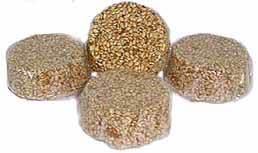
 Gajak is a dry sweet. It is popular Indian dessert made on several festivals. Since this sweet was first prepared and made popular in jaipur , it has its name as "Jaipur Ki Gajak". It is usually prepared during festivals like Baisaki or Teej which is celebrated widely in Rajasthan.
Ingredients:
1/4 cup cashewnuts (halved)
1/2 cup sesame seeds (til)
200 gms sugar
2 tblsp pure ghee.
Method:
- Take a tray and grease it with ghee.
- Roast sesame seeds over a low heat up until lightly brown.
- Similarly, roast cashew nuts till they turn golden brown.
- Take ghee left over. Add sugar and 2 tblsp water to it. Stir fry the mix on medium flame till the syrup becomes of thick consistency.
- Take off the syrup from the flame. Add cashew nuts and sesame seeds and mix then well.
- Pour this mixture on the buttered tray and level it evenly.
- Cut it into desired shape and size. Keep it to cool. Make cuts as per the required size and shape and allow to cool.
- When cold, separate the pieces and serve.
Making Time: 50 minutes.
Serves: makes around 20 pieces approximately
Shelflife: 1 week
Note: To get the Gajaks in desired shapes , use cutters which are available readymade in markets of different shapes and sizes.
Click here to know more about Rajasthani foods and cuisines - Introduction to Rajasthani Foods And Cuisines.
Click here to know more about of Indian Sweets and Desserts- An Introduction To Indian Sweets And Desserts.
 Ghevar is a sweet specialty from Jaipur. It is a round cake made from daal or flour mix soaked in ghee and milk and topped with sliced almonds. Ghevar is a Rajasthani delicacy especially prepared during the festivals of Teej & Rakhi. A delicious sweet consisting of a spongy wedge made from refined flour & clarified butter is liked by many. This Rajasthani delicacy is made with the help of a mould. So one can also use a wok or small moulds.Ingredients:
3 cups Plain Flour
1 cup Ghee
3-4 icecubes
4 cups water
1/2 cup Milk
1/4 tsp Yellow Colour
1 kg Ghee
Syrup:1 1/2 cups Sugar
1 cup Water
Topping:1 tsp Cardamom Powder
1 tbsp Almonds chopped
1 tbsp Pistachios
1 tbsp Milk
1/2 tsp Saffron dissolved in milk
Silver foil
Method:
- Prepare sugar syrup of 1 thread consistency and keep aside.
- Take solidified ghee in a large wide bowl.
- Taking one ice cube at a time rub the ghee vigorously.
- Take more ice cubes as required, till ghee becomes very white.
- Add milk, flour and 1 cup water. Mix to make smooth batter.
- Dissolve colour in some water and add to batter.
- Add more water as required to make the batter of thin consistency. (it should run off easily when pour from spoon).
- Take a aluminum or steel cylindrical container with diameter 5-6" and height at least 12".
- Fill half the container with ghee. Heat. When ghee is smoky hot, take a 50 ml, glassful of batter.
- Pour in centre of ghee, slowly in one continuous thread like stream.
- Allow foam to settle.
- Pour one more glassful in hole formed in centre.
- When foam settles again, loosen ghevar with an iron skewer inserted in hole.
- Lift carefully, at a slant, and place on wire mesh to drain.
- Keep hot syrup in a wide flat-bottomed container to fit in ghevar.
- Dip ghevar in it, and remove, keep aside on mesh to drain excess syrup.
- Alternatively pour some syrup evenly all over, keeping ghevar in a mesh placed over a container.
- Cool a little, top with silver foil.
- Splash a few drops of saffron milk, sprinkle some chopped dry fruit like almond and a few pinches of cardamom powder.
- Ghevar is ready to be served.
Making Time: 1 hour
Serves: 5 persons
Shelflife: 1 day.
Note: Ghevar needs to be done carefully. So just follow the steps one by one as prepare it as given.
Click here to know more about Rajasthani foods and cuisines - Introduction to Rajasthani Foods And Cuisines.
Click here to know more about of Indian Sweets and Desserts- An Introduction To Indian Sweets And Desserts.
 Chikki is candy loved by indians all over. A universally popular snack form the western part of India, but made in a similar manner all over the country and even abroad. Chikkis are popular in Maharahtra, konkan region , gujrat and tamilnadu. but the method too remains same all everywhere.Ingredients:
Groundnuts – one and half cup
Sugar or jaggery – about one cup
Ghee – 2 teaspoons.
Method:- Roast the groundnuts in a kadai on a medium flame.After it cools, rub off the skin and crush lightly with hand .
- Grease a plate with ghee and set aside .
- Melt the sugar in a thick bottomed kadai over a very low flame.
- When it has melted and turned slightly golden, remove from the flame and add the nuts while stirring briskly.
- If you are using jaggery follow this method. Heat jaggery (or sugar) in water to create a thick syrup. Test by adding one drop in cold water. If the jaggery remains firm, then consistency is correct.
- Add roasted peanuts, and immediately spread on the greased board.
- Roll out flat to 1 cm thickness, and allow to cool.
- Cut into squares when cool.Store in an airtight box.
Making time: 35 minutes
Serves: 4 persons
Shelflife: 2-3 weeks if stored in airtight container.
Note: Though sugar or jaggery , any one of them can be used to prepare chikki, I would recommend to use jaggery. Jaggery gives chikki a good taste and also keeps it little soft making it easier to chew and eat. Also jaggery is better than sugar in terms of nutrition and health, since it contains iron and also doesnt add up more calories.
Click here to know more about Gujrati foods and cuisines- An Introduction To gujrati cuisines and Recipes.
Click here to know more about Maharashtrian Recipes and cuisines-
Introduction To Maharashtrain Recipes.Click here to know all about Tamil Nadu cuisines-
Introduction To Tamil Nadu Cuisines And Recipes.
Click here to know more about of Indian Sweets and Desserts- An Introduction To Indian Sweets And Desserts.
 The churma , very ancient and well known Rajasthani cuisine is prepared in a particular method, though it is time consuming, it is delicious and worth all efforts. It needs a initial preparation of flour kneeded into dough. The dough looks like the one in above picture. This dough is later partitioned into smaller balls, which are deep fried and powdered to make the churma.
 The dough which is deep fried and powder looks like the above pic. This powder is later cooked with jaggery to and decorated with nuts. Though is seems long process, it is a cuisine which is a must try for indian food lovers.
 Churma is a popular delicacy usually served with baatis or dal baati. It is coarsely ground wheat crushed and cooked with ghee and sugar. Traditionally it is made by mashing up wheat flour baatis or left over rotis in ghee and jaggery. Churma is a very basic Rajasthani sweet. Churma is made using wheat flour, ghee and jaggery which are the main ingredients and the only ingredients.Ingredients:
200 gms Wheat flour
150 gms of Ghee
100 gms Khoya / Mawa (optional)
200 gms Grated Jaggery ( or powdered sugar)
4 Cardamom (small)
250 of ghee for deep frying (can be substitued with either vanaspati or ordinary vegetable oil).
For Garnishing:10-12 Soaked almond finely chopped
10-12 pistachios finely chopped.
Method:- Melt 150 gms. of ghee and mix it in wheat flour.
- Make a stiff dough using very little water.
- Heat the rest of the ghee in a kadahi or a deep bottomed pan
- Make about 15-20 balls with the dough.
- Fry it on low flame till it becomes golden brown.
- Allow the balls to cool for somewhile.
- Churn it in grinder after it cools down. Dont grind the balls too finely .
- Mix khoya. Khoya or Mava is just optional , to give the churma a rich taste. So this khoya or mava can be avoided for better health reasons and economical values.
- Heat 1 tbsp. ghee in kadahi.
- If sugar is used as sweeter, follow this step. Add the cardamom seeds and the churma mixture and fry for 1-2 minutes.
- When it cools down add sugar and mix well.
- In case jaggery is used, then grate the jaggery and cook the jaggery to a consistent paste.
- Add the churma mixture to the jaggery paste and mix well till the churma turns soft and there are no lumps of jaggery left.
- Add cardamom seeds to the churma and mix well.
- Serve churmas and granish it with chopped almonds and pistas.
Making Time: 45 mintes.
Serves: 4 -5 persons.
Shelflife: 1 day.
Note: The churmas are prepared in jaggery in Rajasthan . Also Jaggery is considered and is good for health than sugar. Sugar can used to avoid the long process. But i recommend using jaggery, it gives the best taste to churma. Few people add Dalchinis (Cinamon stick) in this recipe. It is usually added when 1 tbsp of ghee is heated for preparing churma and is added along with cardamom sticks. But churma tastes good when Cinamon stick is avoided.
Click here to know more about Rajasthani foods and cuisines - Introduction to Rajasthani Foods And Cuisines.
Click here to know more about of Indian Sweets and Desserts-
An Introduction To Indian Sweets And Desserts.

 Shakara Varatti is a special chips prepared in kerala. It is unique in taste and can be found in almost every Malayali household. This chips has the meaning and the description of its name in the name itself. Shakara varatti is a Malayalam word (language spoken by people of Kerala). Shakara means sweet and varatti means coated. Yeah right, this chips is sweet in taste and it is coated in jaggery which gives it this unique taste , hence it has this name.
 I have few malayali family friends and also i have few malayali friends while i was in college and i had a good opportunity to taste and explore their food and recipes. Kerala recipes are quite simple and not much complicated to prepare. Kerala being a coastal state , malayalis use things which are commonly and easily available in abundance over there. Being a coastal area, it is abundant in coconut trees, banana tree , rice , fish and ground vegetables. That being a reason, you can see many keralities using coconut and coconut oil for cooking. Coconut oil is believed to have many health benefits and beauty benefits. Well let me come to the recipe. Its a delicious recipe which almost tastes like a traditional candy. It requires less ingredients but needs good concentration of mind and little patience for preparing this recipe. But the secret of making any recipe delicious is just prepare with love and affection and serve it much love and affection even the worst made food would taste delicious.







 Posts
Posts


