 Bhel puri is a street food popularly called as "chaat food". It is a puffed rice dish mixed with some common veggies like mashed potatoes, chopped tomatoes , onions and some tangy chutneys like tamarind chutney and mint chutney. One can see Bhel puri on the streets of Mumbai and for those who want to catch a glimpse of how popular this food is , then just look at the popular mumbai spots like juhu beach, chowpaty where lots of people simply love eating them during evening time.
 Bhel puri is prepared all over India these days but the name differs from place to place. It is called Churu Muri is Bangalore, Jhaal Muri in Kolkata and so on. The other types of chaat that are famous are paani puri, sev puri dahi puri and so on.Bhelpuri was originally a Gujarati food. It later got merged with Mumbai culture and became synonymous with Mumbai. Bhelpuri is best consumed as soon as it is made. If left for a while, the juices from the tomatoes, chutneys, etc. combine to render the sev and mamra soggy.Though these days Bhelpuri has many variations like chana bhel, chinese bhel , diet bhel, kurkuri bhel, dry bhel and many such bhels. The basic Bhelpuri is made from puffed rice, sev (a fried snack shaped like thin noodles made from besan flour) , some friend snacks, and veggies like finely chopped onions, tomatoes, chillies, Coriander leaves( for garnishing), boiled and mashed potatoes along with different kinds of chutney to add sweet, tangy and spicy flavour like tamarind chutney and mint chutney. Different chutneys impart a sweet or spicy flavour. There are two popular chutneys used, a dark purple sweet one made mainly of dates and tamarind, and a green spicy chutney made of coriander leaves and green chilis.Another variation is to sprinkle the chat with chunks of diced sweet mango.Even raw mangoes goes excellent in bhelpuri if chopped finely. The finished snack is often garnished with a combination of diced onions, coriander leaves and chopped green chilis. It is sometimes served with papri puris, a deep fried small round and crispy wheat bread. The result is a sour/pungent/sweet tasting evening snack that is a treat for the tastebuds and a good source of carbohydrates and minerals. Some people add cucumber, and other veggies of their choice as per preference in these days.Over all, bhel puri is a excellent evening snack , a quick to make recipe and nice to treat the evening hunger. Modern versions of bhelpuri includes, dry bhel, chana bhel, chinese bhel etc where ingredients are adjusted as per one's taste and preference keeping in mind the diet and taste of person. But nothing can ever beat the original Bhelpuri . It is just perfect indian snack. A snack with almost iconic status in Western India, bhelpuri is low-fat, nutritious and delicious!Ingredients:
1 cup Puffed Rice (Kurmura)
1/2 cup chopped Tomato (Tamatar)
1/2 cup chopped Onion (Pyaj)
1/4 cup chopped Coriander Leaves (Dhania Patta)
1/2 cup boiled and mashed Potato (Aloo)
4 chopped Green Chilli (Hari mirch)
1 tblsp Garam Masala or Red chilli powder (use red chilli powder mostly)
1/4 teaspoon Turmeric powder
6 tblsp Tamarind (Imli) Chutney
6 tblsp Coriander Leaves (Dhania Patta) And Mint Chutney
1/2 cup Nimkis
1/2 cup Sev
1/2 cup Gol gappas
2 tblsp Lime or Lemon (Nimbu) Juice
1/2 cucumber grated (optional)
1 carrot grated (optional)
For Garnishing:
1/2 cup sev
5-6 papdis
2 tablespoon Chopped coriander leaves
1 tablespoon Chaat Masala
For Green Chutney:
Coriander leaves / Cilantro - 1/2 bunch
Green chillies - 6 nos
Potato wafers - 1 tablespoon (optional- just to give some thickness)
Salt - as per taste
Lemon juice - 1/2 tablespoon
For Tamarind Chutney (Sweet and Sour Chutney):
Tamaraind Extract - 1 cup
Pitted Dates - 1 /2 cup
Brown sugar - 1 tablespoon
Black salt - 2 pinches or 1/4 teaspoon
Cumin powder - 2 teaspoons
Red chilli powder - 2 teaspoons
Salt - As per taste.
Method:- Blend all the ingredients of Green chutney and make a fine paste of it. Reserve and keep aside.
- Take together all the ingredients of Tamarind chutney and boil them in a deep bottom vessel till it is reduced to half. Remove from fire and allow it to cool. Grind it to make a smooth consistency of it and keep aside.
- Chop the onions, tomaotoes and chillies finely and keep aside. Cumcumber and carrots are optional. Grate them and keep aside. As such the original bhel puri recipe doesnt include carrots and cucumber but some add for added taste or for garnishing. Even finely chopped raw mangoes or kairi adds good taste to bhel puri.
- Take a deep bottomed large vessel so that it becomes easy to mix the ingredients .
- Put the chopped onions, tomatoes, chillies and puffed rice in the vessel. Mix them properly. Add the mashed potatoes and mix them.
- Now add the powders like red chilli powder, salt, turmeric powder and mix them well.
- Now add the chutneys like tamarind chutney and mint chutney and mix well. The bhel should get coated with the chutney and look reddish orange in colour.
- Now crush the golgappas and few papdis and add them to the bhel. Also add the coriander leaves, sev and sprinkle some lemon juice and mix well.
- Bhel puri is ready to eat. Take a wide plate and put the bhel puri on the plate and garnish it with sev, chopped coriander leaves . Sprinkle little chaat masala on top and place a spoon in the middle of bhelpuri. Do serve this immediately or else the puffed rice would eat up lot of moisture and loose its puffiness.
- Enjoy the spicy tangy bhelpuri .
 Preparation Time :
 20 minutes
Making time: 10 minutes
Serves: 4 persons
Shelflife: Best fresh
Serving suggestion: Serve them fresh immediately after preparing toppled with good garnishing.
Note:- Chop the onions and tomatoes finely.
- You can skip the chillies in case if you dont like it.
- Add 1 tablespoon og tomato ketchup to the bhel while adding the chutney and mix. It gives added taste to the bhelpuri
- If you dont have papdis and golgappas, then crush some Khari and add. It gives the same crunchiness and taste to bhelpuri.
- Sprinkling some chaat masala adds a extra taste to bhelpuri. Some add a pinch of black salt too. Even that gives a good taste.

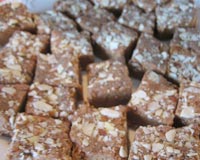
 Chikki is candy loved by indians all over. A universally popular snack form the western part of India, but made in a similar manner all over the country and even abroad. Chikkis are popular in Maharahtra, konkan region , gujrat and tamilnadu. but the method too remains same all everywhere.Ingredients:
Groundnuts – one and half cup
Sugar or jaggery – about one cup
Ghee – 2 teaspoons.
Method:- Roast the groundnuts in a kadai on a medium flame.After it cools, rub off the skin and crush lightly with hand .
- Grease a plate with ghee and set aside .
- Melt the sugar in a thick bottomed kadai over a very low flame.
- When it has melted and turned slightly golden, remove from the flame and add the nuts while stirring briskly.
- If you are using jaggery follow this method. Heat jaggery (or sugar) in water to create a thick syrup. Test by adding one drop in cold water. If the jaggery remains firm, then consistency is correct.
- Add roasted peanuts, and immediately spread on the greased board.
- Roll out flat to 1 cm thickness, and allow to cool.
- Cut into squares when cool.Store in an airtight box.
Making time: 35 minutes
Serves: 4 persons
Shelflife: 2-3 weeks if stored in airtight container.
Note: Though sugar or jaggery , any one of them can be used to prepare chikki, I would recommend to use jaggery. Jaggery gives chikki a good taste and also keeps it little soft making it easier to chew and eat. Also jaggery is better than sugar in terms of nutrition and health, since it contains iron and also doesnt add up more calories.
Click here to know more about Gujrati foods and cuisines- An Introduction To gujrati cuisines and Recipes.
Click here to know more about Maharashtrian Recipes and cuisines-
Introduction To Maharashtrain Recipes.Click here to know all about Tamil Nadu cuisines-
Introduction To Tamil Nadu Cuisines And Recipes.
Click here to know more about of Indian Sweets and Desserts- An Introduction To Indian Sweets And Desserts.
 This is an aluminium contraption in which handvo - a Gujju snack - is prepared. The cooking contraption, I think, is somewhat like a chiffon cake/ angel food cake pan - a very deep tube. It sits on a plate filled with damp sand to help conduct the heat better. It also has a hole in the middle, where you can see the flame rising from in the image. This hole helps cook the center of the handvo.
Handvo is traditional baked cake from Gujrat. Handvo involves lots of preparing process and work and hence needs to cooked carefully. These days Handvo flour is readily available in markets. But traditionally lentsils and grains are soaked and grinded into paste which is then baked in a special utensil which is especially used for cooking Handvo. The closest I can get to describing the handvo is that it is a savoury cake, chock full of grains and vegetables, spices, some oil, and a bit of soda and buttermilk for leavening. It is topped with sesame and coriander leaves which bake the top to a crisp.
Ingredients:
4 cups handvo mix or
2 cup rice
1/2 cup urad dal
1/2 cup toor dal
1/2 cup yellow split moong dal
1/2 cup chana dal
1 bottle gourd (lauki/dudhi/zucchini)- shredded
5-7 green chilies (as per your spice level)
1 inch piece ginger
3-4 cloves garlic
2 cups yoghurt
1/2 tsp soda-bi carb
salt to taste
sugar to taste .
For Tempering:
3 tbsp oil
1 tsp mustard seeds
1/2 tsp cumin/jeera seeds
1/2 tsp turmeric
1/3 tsp red chili powder
1/4th tsp asafoetida
2 dried red chilies
1 tsp sesame seeds.
For Garnishing:
1 tbsp sesame seeds.
Method:
- Soak all the lentils/dal and rice overnight.
- Grind the lentil-rice mixture with some water to form a thick batter.
- Add the yogurt and leave aside for another 5-6 hours in a warm place.
- Alternately if using the ready made handvo mix soak the mixture in yogurt and water overnight in a warm place.
- Add the grated bottle gourd, sugar and salt and mix well.
- Crush the green chilies, ginger and garlic to a smooth paste and add it to the handvo mixture.
- Heat oil, add the mustard and cumin seeds, and when they pop, add the turmeric, asafoetida, chili powder, dried chilies and sesame seeds in that particular order and pour this mixture over the handvo mixture.
- Mix well and transfer the batter to a baking pan.
- Sprinkle with sesame seeds on top and bake at 400 degree F for 45-60 minutes till the top is a golden brown.
- Alternately test by pushing a knife through and if it comes out clean (instead of the batter clinging to it), the handvo is baked.
- Serve hot with some oil on the side.
- Take out. Cut into squares and serve immediately.
Making Time: 45 minutes
Serves: 4 - 5 persons.
Shelflife: 1 day.
Note:
- If you are using a oevn, bake for 45 minutes in a preheated oven, 15 minutes at 200 degree centigrade, and 30 minutes at 180 degrees centigrade.
- If you have doubts regarding the batter consistency or its fluffiness, you can add 1 eno fruit salt to the batter before baking, it would amke the handvo soft.
Variations:
As a variation or to make handvo more nutricious, finley chopped vegetables like carrots, cabbage, potatoes, leeks etc to the batter and mix well and then bake them. Remember to chop them very finely for good texture and good taste.
Click here to know more about Gujrati foods and cuisines- An Introduction To gujrati cuisines and Recipes.

Bateta Jo shaak is a side dish from Gujrat. Spicy dishes are usually from the Kathiwad region of Gujrat. This too is one such recipe. The sabzis or side dish preparation differs from place to place and states in India. Gujrat has its unique style too. " Bateto jo shaak" is thus presented here in the same unique style od gujarati cuisine. Ingredients:
12 small new potatoes; quartered (leave the skins on)
1 tblspn oil
½ tspn cumin seeds
½ tspn mustard seeds
3 large tomatoes; blanched, peeled and crushed
2-3 cloves garlic; crushed
1 ½ inch ginger; grated
2-3 green chillies; chopped fine
¼ tspn tumeric
2 tspn coriander / cumin powders
salt to taste
Coriander leaves and stem; chopped.
Method:
- Heat the oil in a saucepan, add the cumin and mustard seeds.
- When the seeds crackle, add the potatoes and fry them till they are cooked.
- Add the tomatoes, cook for a few minutes, cook them till the tomatoes are tender soft.
- Add the garlic, ginger and chillies, mix and cook for a further 5 minutes .
- Add the salt, tumeric, coriander and cumin powders, mix and cook until the potatoes are cooked.
- Garnish with the chopped coriander leaves.
- Serve hot with rotis, puris or Steamed Rice.
Cooking Time: 25 minutes.
Serves: 4 persons.
Shelflife: Best fresh.
Note: Try using Non stick pan if you find frying the potatoes at intial stages. DO strir the potatoes time and again. Since water is not added to this recipe, close the pan or vessel with lid and keep on low flame. The steam itslef helps in cooking the potatoes further.
Click here to know more about Gujrati foods and cuisines- An Introduction To gujrati cuisines and Recipes.
 Moong daal Chilla is a variation of chilla and is little different from ordinary chilla. Instead of using flour, here daal is soaked and grinded to paste and chillas are prepared. This chillas taste good and can be served with any chutney and also can be taken as breakfast, lunch or for brunch at dinner.Ingredients:
1 cup Yellow Moong Dal
¼ cup White Urad Dal ( or chickepeas a handful)
2 cups Finely Chopped coriander leaves or cilantro
1 large onion sliced finely
2 green chilies chopped finely (optional while giving children)
1 teaspoon Cumin Seeds
1 teaspoon Turmeric Powder
1 teaspoon fennel seeds
Salt to taste
Vegetable/Sunflower Oil.
Method:- Soak the Yellow Moong Dal and Udat Dal together for 2 hours. Grind into a fine paste by adding 1 ½ cups of water (use the water used for soaking for grinding).
- The batter should be of thick pouring consistency.
- In the mean while, heat frying pan, crackle the cumin seeds, fennel seeds and add the sliced onions. Sauté on medium heat till the onion changes color.
- Add the sautéed onions, chopped coriander leaves, chopped green chilies (optional), turmeric powder and salt to the lentil batter.
- Heat the non stick griddle on medium heat.
- Pour 1 ladle full of batter on the griddle in the centre and spread it outwards in circular way. Using the back of the ladle spread the batter into a circle
- Make sure the chilla is not too thick so it gets cooked evenly.
- Add a little oil along the edges of the chilla, cover and cook for 2 minutes.
- Turn the chilla over and cook on the otherside until it gets brown patches.
- Remove and similarly prepare chillas out of remaining batter.
- Serve hot with any chutney or tomato ketchup.
Making Time: 30 mnutes ( excluding soaking and grinding time).
Serves: makes 8 chillas .
Shelflife: Best Fresh.
Note: As a variation, add vegetables to this like shredded or chopped cabbage, peas, carrots etc to make it more nutritious and tasty.
Click here to know more about Gujrati foods and cuisines-
An Introduction To gujrati cuisines and Recipes.
 Chillas are spiced lentil crepes served hot in breakfast or as a main dish during a meal. Chilla's is popular in Gujrat and Rajasthan. It is served with mint chutney, curd or any tangy thing. Chilla's are called veg omletes, since varieties can be made out of it. Vegetables and spices can be added to chillas to make it more tasteful. The soft nature of the crepes makes it very suitable for the children to chew and digest as well. There are several ways of preparing a Chillas with varities in it. Here i am posting the basic and simple chilla made from gramflour.
Ingredients:1 cup gram flour
1 cup yogurt
1/2 cup warm water
2 cloves garlic – minced
½ inch ginger – grated
2 chillies - minced
2 spring onions – chopped finely
2 table spoons chopped coriander
Salt to taste.
Method:- Mix the flour and salt together in a bowl, add the yogurt and mix, to make a smooth paste.
- Add the water gradually until it has a consistency of pancake batter.
- Beat it nicely till it becomes a smooth batter.
- Leave aside for 1 hour.
- Beat again and add garlic, ginger spring onion, chilli and coriander leaves.
- Mix well and take care to see there are no lumps formed.
- Heat a pancake tawa or pan. Spray little oil or rub little oil on base of pan.
- Pour 1 ladle of batter in the centre of the pan and spread it evenly, flatten it outwards in circular way.
- Pour little oil on the outer edges of the pancake.
- Roast on one side. Flip and roast the other side till browned evenly.
- Repeat the same with remaining batter. Serve hot with coconut chutney or mint chutney.
Making Time: 20 minutes( excluding setting time).
Serves: makes 4 chillas.
Shelife: Best fresh .
Note:
- As a variation, add some finely chopped cabbage, carrots , peas , corns and tomatoes to make it more nutrious and healthy.
- If you dont have besan at home, then roast chanal dal /bengal gram till the aroma is released and it turns pinkish or light brown. Then cool it at room temperature by spreading on a clean cloth at room temperature. Then blend this into a coarse mixture . and the flour is ready.
- The flour can also be grinded finely, but to avoid lump, coarse flour would be best choice.
Click here to know more about Gujrati foods and cuisines- An Introduction To gujrati cuisines and Recipes.
 Gunda nu kairi is a pickle , very famous from the state of gujrat. In this recipe, a particular kind of berry called gunda is used in preparation of pickle. Gunda looks like the the fruit in the above pic. Gunda has a big seed in it middle, which is removed before preparing the pickles. Also its stem is cut off and the gundas are washed and cleaned before using them to prepare recipe
.
Gunda is a kind of berry which along with kairi means raw mangoes is salted and spiced to make pickle which can be stored for long. This pickle goes well with anything from rice to rotis and is economical. Gundane kairi jo athanu or gunda kairi pickle is popular pickle from gujrat. It is normally prepared in huge amount and stored for long. Here, i am giving the step by step details of preparing this recipe traditionally and easily at the same time.
Ingredients:
Gunda - 2 kilograms
Raw mangoes - 1½ kilograms
Sea salt, ground ½ cups
Lemon juice - 5 lemon's juice.
For Masala:
1 cup split/hulled mustard seeds
1/2 cup coarsely ground coriander
1/2 cup coarsely ground fenugreek
1 teaspoon fennel seeds
2 sticks cinamon
4 whole cloves
3 cardomom pods
8 whole black pepper
1 and 1/2 cups oil
1 cup ground red chilies
2 teaspoons tumeric powder.
Method:
- Place the whole spices in a pan.
- Heat the oil in another panAdd the oil to the spices.
- Add chillies and tumeric to the masala mix , cool it and use to make pickle (it is enough to make pickles for 3 preparations so u can store and use later too).
- Cut the gunda and scrape the seeds with a salted knife.
- Wash and dry the mangoes and gunda.
- Mix the lemon juice and salt in a bowl.
- Cut the mangoes into small pieces keep aside.
- Split the gunda, remove the seed, and place in the lemon juice.
- Add the mangoes to the lemon juice and salt mixture and mix well leave overnight at room temperature.
- The next day, discard the lemon juice and spread the mangoes and gunda on a dry tea towel, leave to dry for one day.
- Take a clean jar, place 1/2 cup of oil in the jar.
- Stuff the gunda with 2 tspn of masala and place in the jar.
- Or else mix in the gunda and the mango pieces cubes to the masala mixture and mix till all of them are well coated with the masala.
- Place the mangoes in between the gunda.
- This pickle will be ready to eat in 1 months time.
- Store it in the fridge, but a cool place should be fine
Making Time : 45 minutes (excluding time of soaking and allowing to cool and get prepared).
Serves : serves for a family of 4 for 3-4 months.
Shelflife: Upto 1 year.
Note:
- Apply a little oil and salt to your hands before handling gunda. Split them and remove the seeds. Also place the knife in salted water or apply salt to it and leave for 30 minutes before using them for scraping off the seeds.
- Instead of placing the mango cubes and gundas in lemon juice, it can also be applied salt and turmeric and left for few hours. In that case leave it for 2-3 hours. And discard the excess water it leaves due to salted marination.
- Always transfer the pickles into sterilized glass or porcelain bottles, packing it tightly to remove any air bubbles. Sterilized bottles means , take a good glass jar with tight lid, clean it properly and place it in hot water for few minutes for about 30-40 minutes. Then remove it and dry it up completely and make sure it is not wet before placing the pickles inside them .
- As a another option, heat the remaining oil to smoking point, cool and add it to the pickles. Again cover and keep for at least ten to fifteen days. (In case the masala is not prepared or ready before hand).
- The preparing process for the pickles to get ready usually takes weeks . Best is for three weeks by which time the oil will surface and the pickle will be ready to eat.
Click here to know more about Gujrati foods and cuisines-
An Introduction To gujrati cuisines and Recipes.
 Masala puri is indian bread variety but spicy in taste. Originally Masala puris are native to kathiwad region of Gujrat and Rajasthan. This puris at times dont need any accompaliance and can be taken as it is. People do make variations in masal puri, but here i am posting the original method of preparing masal puri.Ingredients:
1 cup - Wheat flour
2 tsp - Oil + Frying
Salt to taste
1/4 tsp - Ajwain
1 pinch - Asafoetida
1/2 tsp - Red chilli powder .
Method:- Sieve the wheat flour and salt.
- Mix all the ingredients and knead to firm dough adding enough water.
- Cover and keep the aside for half an hour.
- Take small lumps of dough and roll into small puris.
- Heat oil in a kadhai and deep fry the puris.
- Serve masala puri hot with curry of your choice.
Making Time: 25 minutes.
Serves: makes 6 puris.
Shelflife: 1 day.
Note: A small pinch of soda bi-cab can be added while kneeding the dough to make it soft.
Click here to know more about Gujrati foods and cuisines-
An Introduction To gujrati cuisines and Recipes.
 Chundo is a pickle but is sweet in taste. Often chundo is called as indian jam since it goes very well with breads . Chundo is made from raw mangoes which is grated and sugar is added to it and it is kept under sunlight instead of cooking. This chundo is cooked in sunlight and this makes it preserve for long and gives a different taste as well. Here i am giving the age old traditional way of preparing chundo with the exact things to be followed to get it perfect. So read and follow properly.Ingredients:
3 Rajapuri mangoes peeled grated and weighed.
Sugar 1.5 times the volume of mango
Salt, a little less than half a cup
Turmeric - 1 tbsp
Cumin seed 1 tbsp
groundChilli powder 2 tbsp.
Method:- Peel and grate mangoes. Mix with the salt and haldi and leave for about half an hour.
- Now taking a little at a time sqeeze gently and put the dried pulp into clean steel vessel.
- To the pulp add the sugar and mix well.
- Tie a piece of muslin over the mouth of the vessel and place in the sun.
- Now, if you want to do it right and have the patience, then keep the chunda in the sun for full 21 days.
- Every morning, stir it once nicely, place it under sun and at night take it indoors.
- The pickle is done when the sugar has melted to a syrup and reaches a 1.5 - 2 string consistency. (to test, take a smidgen of syrup between your thumb and forefinger. When you pull them apart, they should form 1.5 to 2 threads).
- When done, add the chilli powder.
- If well sunned and taken care of the pickle will keep for a year without refrigeration.
Other option:
For those of you not wanting to wait for the pickle to cook in the sun there is an easier option, but be warned it will not taste the same. (It is almost like the flavor of sunlight is captured in this pickle!) .
- Place a heavy bottomed kadai on fire and put mango-sugar mixture in it.
- Cook till all the water has evaporated.
- Keep stirring to avoid sticking at bottom of vessel.
- Cook it till it reaches to 1.5 or 2 thread consistency.
- Add chilli powder while still hot.
- Remove from fire. Chundo is ready. Keep it in airtight container when it cools down.
Making Time: 22 days.
Serves: many
Shelflife: 1 year.
Note:
Selection Of Mangoes:
- MANGOES - Rajapuri mangoes is what the recipe calls for, these are large mangoes and are used raw and firm. The idea being that the pickle on being done should hold the form of the slivers it has been grated into.
- Over Ripe Mangoes -Dont go for mangoes which are not firm or if they are ripe. They wont make a good chunda but a chutney of it.
- Katki kairi Pickle - Instead of Chunda, go for "Katki Kairi Pickle" (a variation of the Chunda) Chop the mangoes into tiny dice, instead of grating them and then cook them on the gas like the gas cooked chunda.
Other points to be noted:
- If you want to add texture, maybe you can add raw firm papaya to the grated mango.
- The Sun is the other variable Remember the sun is very hot in India averaging 38-40 degree Celsius so vary the amount of days accordingly, if its really hot where you are then 3-4 days will suffice, but if the intensity is lower then the number of days will vary between 4-8 days.
- If you notice that there is crystalisation happening, then the sugar ratio is too high, you need to grate and salt some more mango and add it in so keeping one mango spare might be a good idea for the duration, (if you dont use it in the chutney then refer to the bottom of the post for another recipe you can use) it up in.
- Watch out for ants! THe muslin is to keep them and other stuff that might get in out, but this stuff is ant magnetic so extra precaution of placing it in a bath of water should help. Dont let the water get into the pickle though.
- Remember to take the bowl inside every evening. To stir and place outside every morning. When done, add the chilli powder. Crush the other spices coarsely and add to pickle. Be careful not to touch a wet spoon to the pickle. If taken care it, the pickle is kept for a year without refrigeration.
Click here to know more about Gujrati foods and cuisines- An Introduction To gujrati cuisines and Recipes.
 Makai na bharta is a kathiwad cuisine which belongs to the state Gujrat. It is spicy and can be served with rice, rotis or parathas. Makai means corn and this cuisine is prepared from corn niblets.
Ingredients:
1 tsp coriander powder
1 tsp turmeric powder
1 kg fresh corns
1 tsp red chilli powder
2 tblsp oil
3 medium tomatoes
1/2 tsp garam masala powder
3 medium onions
1/2 tsp cumin seeds
6 - 7 green chillies
salt to taste
coriander leaves chopped for garnishing.
Method:
- Boil the whole corn, take off the niblets and grind it coarsely in a blender.
- Take off and finely cut the onions.
- Wash and cut the tomatoes.
- Wash and cut the green chillies.
- Heat up oil in a kadhai, mix in cumin seeds and stir fry till they crackle.
- Mix in cut onions and stir fry till light brown.
- Mix in cut green chillies and stir fry for 1/2 minute.
- Mix in red chilli powder, turmeric powder, coriander powder, garam masala powder and salt.
- Stir fry for few seconds and mix in cut tomatoes.
- When tomatoes are cooked mix in corn, salt and little water.
- Stir fry for another 5-10 minutes.
- Serve hot decorated with cut coriander.
Making Time: 30 minutes.
Serves: 5 persons.
Shelflife: 1 day(best fresh).
Note: Dont blend the corn niblets finely. Keep it coarse , since it tastes good when coarse.
Click here to know more about Gujrati foods and cuisines- An Introduction To gujrati cuisines and Recipes.

Lasaniya Batata is a cuisine belonging to the kathiwad or saurashtra region of Gujrat , which is usually spicy. The cuisine from these regions consists of flavours of ghee, ginger, jaggery,salt and green chillies. The cuisine from this part are very delicious and can be served with rice or rotis.
Lasaniya the word means garlic , lasaniya is a gujarati word. Lasaniya batata is thus garlic potatoes which is cooked in gravy.
Ingredients:
1 cup bengal gram flour (besan)
1/4 tsp turmeric powder
2 tblsp oil
3/4 tsp red chilli
/2 cup yogurt
10 cloves garlic chopped
1 tsp cumin seeds
2 tsp coriander powder
300 gms, baby potatoes
1tblsp coriander leaves chopped
oil to fry
1/2 tsp garam masala powder.
Method:
- Take off the potatoes and slit from the centre, but do not split.
- Heat up oil and fry till golden on medium heat.
- Heat up 2 tblsp of oil in a kadhai, mix in cumin seeds and stir fry till they crackle.
- Mix in cut garlic and stir fry for a while, but do not let it brown.
- Then mix in gram flour and stir fry for another five minutes on a slow heat.
- Mix in coriander powder, garam masala powder, red chilli powder, turmeric powder and stir fry for one minute.
- Take off the kadhai from heat up and mix in yogurt, a little water.
- Mix and stir fry again.
- Mix in half the cut coriander and the fried potatoes.
- Stir fry on a very slow heat up for 10-15 minutes.
- Serve hot decorated with the remaining cut coriander.
Cooking Time: 30 -35 minutes.
Serves: 3 persons.
Shelflife: 1 day (best fresh).
Note: For this cuisine, select only baby potatoes which are small.
Click here to know more about Gujrati foods and cuisines- An Introduction To gujrati cuisines and Recipes.

Khichu is a well known recipe from gujrat. Khichu is kind of khichdi and is usally served with kadhi and papad.
Ingredients:
1 kg Rice flour
1 tbsp Tamarind pulp
1tsp Ajwain
1/4 cup Water
2 tsp Brown sugar
1 1/2 tbsp Ghee or oil
1/2 tsp mustard seeds or sesame seeds
1/4 tsp soda bi-cab
1/2 tsp Ground turmeric
1/2 tsp Cayenne or ground chili pdr
1 tsp Ground coriander
1 tsp Ground cumin
1 tsp Salt
2 Fresh green chilies, seeded And thinly sliced
2 tbsp Desiccated coconut.
Method:
- Blend together green chillies, cumin seeds and ajwain finely and set aside.
- In a heavy bottom pan heat water double the quantity of flour .
- Add the blended mixture to it.
- Add the soda, salt, turmeric powder, sesame seeds ,brown sugar, turmeric pulp, coriander powder and desicated coconut to this water (do not stir).
- When the water starts boiling , add the flour to it slowly but do not mix or stir it.
- Spread the flour over the water with the help of a spoon and close the vessel with a lid (do not stir or mix).
- keep the flame on low.
- After some 30 minutes, the flour absorbs all the water and water covers the flour over the top.
- Now with the help of a wooden laddle, Stir the mixture in one direction continuously.
- Keep stirring and mixing till all the water is absorbed and the flour comes to dough like texture.
- Remove from fire and serve hot with kadhi or chutney with papads.
Making Time: 45-50 minutes
Serves: 5-6 persons.
Shelflife: 2 days.
Note: Do not stir when the water is boiled and the flour is added. Do not stir them while cooking untill all the water is absorbed by the flour. After that stir continuously and in one direction to make it soft and smooth.
Click here to know more about Gujrati foods and cuisines- An Introduction To gujrati cuisines and Recipes.
 Matri is cuisine from Gujrat. There are different types of Matris like namkeen matri, sweet matri, gol matri etc. Matris are very simple and and tastes simple too. Here i am posting a simple matri in the simple method.Ingredients:
1 cup plain flour
1 tbsp. ghee or oil
salt to taste
2-3 pinches soda bicarb
1/4 tsp. ajwain seeds
warm water for kneading
oil for deep frying.
Method:- Mix all ingredients, except oil for deep frying and water.
- Add water little by little kneading into a pliable dough.
- Cover and keep for 15 minutes.
- Break into small portions, roll in 1" wide rounds.
- Keep a little thicker than puris. Prick with a fork.
- Place on a clean spread out cloth.
- Similarly prepare all the matris (puris) .Finish for all dough.
- Heat oil in a frying pan, add some matri at a time.
- Fry till lightly golden, flip side and repeat.
- Drain and cool to allow to become crisp.
- Store in an airtight container.
Making time: 40 minutes
Makes: 25 pieces (approx.)
Shelflife: 2 weeks at room temperature.
Note: Keep on low flame while frying matris. Also turn them carefully, since it tends to break soon due to delicacy.
Click here to know more about Gujrati foods and cuisines-
An Introduction To gujrati cuisines and Recipes.
 Osaman is a watery gujrati daal made of yellow or red lentsils. It is more or less like brotch or soup and is accompanied with rice. It has a sour and sweet taste which makes it unique and yummy to eat.Ingredients:
2 tblsp coriander leaves chopped
2 tblsp peanuts roasted
4 green chillies sliced
150 gms red grams divide (masoor dal)
1/2 tsp turmeric powder
1 tsp cumin seeds
1 tblsp mustard seeds
1/2 tsp fenugreek seeds
12 curry leaves
a big size pinch asafoetida
2 tblsp oil
2 tblsp jaggery grated
2 tblsp tamarind pulp
Salt to taste.
Method:- Dilute the tamarind pulp in 4 tblsp of water and see that there are no lumps.
- Wash the lentils and bring them to boil in 200 ml water, then simmer.
- When nearly done, mix in turmeric, tamarind water, green chillies, jaggery, peanuts and salt.
- Simmer (boil slowly at low temperature) until dal is cooked.
- Heat up the oil in a small pan, mix in the mustard seeds when they crackle, mix in cumin seeds, asafoetida, fenugreek seeds and curry leaves.
- Take off the heat up after a minute and pour out the oil and spices into the dal.
- Serve hot decorated with coriander leaves.
Cooking Time: 30 minutes
Serves: 3 persons
Shelflife: 1 day.
Note: Any daal red or yellow dal can be used for this cuisine. It should be watery in consistency.
Click here to know more about Gujrati foods and cuisines- An Introduction To gujrati cuisines and Recipes.
 Magaj is a delicious sweet from Gujrat. It is prepared from Chickpea flour or besan with khoya (indian sweet cheese) and sugar. It is prepared on festive occassions and is tasty.Ingredients:
500 gm Chick pea flour
50 gm Khoya
250 gm Sugar
2 tsp Green cardamom powder
10 Pistachios, blanched
10 Almonds, peeled and blanched
250 gm Ghee.
Method:- Combine the chick pea flour with 1/2 of the ghee and sift it through a sieve.
- In a wok or kadai, heat the remaining ghee and the sifted besan.
- Fry until the besan is golden but not brown and the raw odour of the besan is gone.
- Add the khoya to this and stir on low flame, set aside.
- Make sugar syrup of one thread consistency and add this syrup and cardamom powder to the fried besan, mix properly.
- Pour this mixture on a plate that has been greased with oil.
- Decorate it with blanched pistachios and almonds.
- Cut Magaj into diamond shapes.
- Let it cool.
Making Time: 45 minutes.
Serves: makes 20- 24 pieces
Shelflife: 1 week.
Note: Store magaj in a air tight container to longer shelflife. While frying the Besan in ghee, keep stirring continuously to avoid browning of it.
Click here to know more about Gujrati foods and cuisines-
An Introduction To gujrati cuisines and Recipes.
Click here to know more about of Indian Sweets and Desserts- An Introduction To Indian Sweets And Desserts.

Oondhiyo is a delicious vegetable brew made from many vegetables like potatoes, yam , brinjal, yam and many such vegetables. Traditionally , it is made in earthen pots buried in the ground with fire lit above, the flavour is enhanced with oil and green chutney which is usually blended and added to it. It is a must try gujju recipe with its awesome taste and beautiful colour.
Ingredients:
Potatoes - 1/4 kg
Papdi Beans - 1/4 kg
Brinjals -1/4 kg
Yam - 100 grams (suran)
Bananas - 2 nos. ( raw bananas)
Grated Coconuts - 2 cups
Green chillies - 5- 6 nos
Garlic cloves - 8-10 nos
Chopped ginger - 1 tbsp
Coriander leaves - 1 cup
Turmeric powder - 1 tsp
Coriander powder - 2 tbsp
Red chilli powder - 1 tbsp
Sugar - 1 tsp
Asafoetida - 1 pinch
Oil - 5-6 tbsp
Soda-bi-carbonate - 1/4tsp
Sweet potatoes - 2 nos
Lemon juice - 2 tbsp
Salt to taste.
For Dumplings:
Oil -1 tbsp
Methi (fenugreek leaves) finely chopped - 100 grams
Red chilli powder - 1tsp
Fresh ground coconut - 1tbsp
Gram flour (Besan) - 1/2 cup
Asafoetida - 1 pinch
Turmeric powder - 1/4 tsp
Salt to taste.
Method:
For Dumplings or Muthiyas:
- Mix all the muthiya ingredients and prepare a firm dough.
- Divide into small portions and shape each into one-inch long half-inch thick rolls.
- Deep fry in hot oil, remove and keep aside.
For Oondhiyo:
- Wash, take off and dice potatoes, yam and raw bananas.
- Wash brinjals and slit them into four without cutting the stem.
- Make a paste of garlic, green chillies and ginger.
- Mix together coriander leaves, salt, turmeric powder, coriander powder, red chili powder, grated coconut and the ground paste.
- Stuff the mixture inside the brinjals.
- Rub the vegetables with oil and masala paste. Marinate for 30minutes.
- Heat oil in a deep-bottomed pan, add asafetida, and the marinated vegetables.
- Mix the soda with ¼ cup water and add into the vegetables. Cook on high flame for 5 minutes.
- Cover and cook on low heat till the vegetables are almost done (cook for 15-20 minutes
- Then add the dumplings or the muthiyas.
- Add lemon and sprinkle some water if required ( add a cup of water).
- Cover and simmer. Cook on low flame for some 5 minutes.
- Shake the vegetables occasionally but do not use a spoon to stir
- Add sugar, stir. Serve hot, either as is, or with parathas.
- Serve hot decorated with scraped coconut.
Making Time: 50 minutes.
Serves: 4 persons.
Shelflife: 1 day.
Note: If masalas (mixture of paste and other stuffs) are more in quantity, then add the masala to the tempering first and then spread or put the marinated vagetables above it making a layer. It would give a good taste and aroma to the Oondhiyo.To check if the muthias are done, insert a toothpick in the centre. If it comes out clean, the muthias are cooked.
 Basundi is a popular recipe from Gujrat. Baundi is a kheer , sweet dessert which is often prepared during special occassions and festive times. Its a tempting sweet and must try for food lovers.Ingredients:
1 1/2 litre milk (full fat milk)
Cardamom: 3 pods .
saffron a few strands
1/2 cup almonds
8 - 10 pistachios
3/4 cup sugar
2 tblsp sunflower seeds (chironji).
Method:- Soak almonds in warm water to blanch.
- Take off the skin.
- Reserve a few for garnishing and make a paste of the rest (make paste of about 2 tbsp)
- Soak saffron in 2 tea spoons fo hot milk and keep it aside.
- Chop finely and crush coarsly, the almonds and pistachios.
- Peel and powder cardamom seend with a mallet.
- Add it to the chopped dry fruit mix.
- Make small pieces of saffron in a cup, and dissolve it in milk.
- Pour milk in a large deep pan, on medium flame and stir ocassionally.
- When it starts boiling, reduce the heat and continue to boil.
- Stir frequently, till milk is 2/3 in volume.
- Add all the dry fruits and cardamom to the boiling milk.
- Add the paste of dry fruits to the boiling milk.
- Also add the chironjis.
- Boil further for 3-4 mins.
- Turn off the stove and allow it to cool a little.
- Pour this mixture into a large decorative serving bowl.
- Allow to cool completely, chill in refridgerator for 4-5 hours.
- To avoid a layer forming on the surface, stir frequently while cooling.
- Serve chilled in individual cups and garnish it with some strands of saffron.
Making Time: 1 hour
Serves: 2 persons
Shelflife: 1 day.
Note:
- Basundi id preferred by some in thin consistency and by some in thick consistency. For a thin consistency dont add the nuts paste and for thick consistency, add the nuts paste prepared.
- Basundi has got high calorie amounting to some 1995, so in order to cut down calorie, you can use low calorie sugar available in market.
Click here to know more about Gujrati foods and cuisines-
An Introduction To gujrati cuisines and Recipes.
Click here to know more about of Indian Sweets and Desserts- An Introduction To Indian Sweets And Desserts.
 Methi theplas are very popular cuisine from gujrat. Methi theplas are good and healthy for diabtes people. They are spicy in taste and can be stored for 2-3 days at room temperature.Methi leaves also called as fenugreek leaves is used to prepare methi theplas.Ingredients:
1 cup wheat flour
1/4 cup of gram flour
1 bunch methi leaves (fenugreek leaves)
1/2 bunch coriander leaves
2tbsp of oil
1tsp sesame seeds
1/2 tsp cumin seeds
3 green chillies crushed
2tsp red chilly powder
1/4 tsp turmeric powder
Salt to taste
Yoghurt for mixing (approximately 1 cup).
Oil for shallow fry.
Method:- Wash the leaves and chop them finely.
- Seive the flours together.
- Mix all the ingredients except oil for shallow fry .
- Knead into soft dough using as much as yoghurt as required.
- Divide the dough into 12 small parts and make smalls of it.
- Roll this balls into chapatis of 5inch or 6inch diameter as per choice.( i prefer6inch diamter)
- Sprinkle flour while rolling , it makes it easier to prepare the theplas.
- Heat a tava or griddle.
- Shallow fry the thepla over tava on both the sides till they are cooked, baked and change its colour to little brown.
- Similarly repeat the process for remaining balls and make theplas of them.
- Cool them in room temperature.
- Serve with chutney (green chutney also called coriander chutney).
Making Time: 25 minutes.
Serves: 12 theplas.
Shelflife: Can be stored for 2-3 days if packed in foil and stored in air tight container at room temperature.
Note: Theplas can be made crisper by not applying oil while heating them over tava.
Click here to know more about Gujrati foods and cuisines- An Introduction To gujrati cuisines and Recipes.
Click here to know more about Indian Breads - Introduction To Indian Breads.
 Fafda is a savoury from Gujrat. It is popular in gujrat and is prepared from chickpea flour known as besan. It is good eatery for tea time snacks and for festive and guest occassions. It is crispy and tastes good.Ingredients:
2 cups Besan
1/4 tsp Baking Soda
1/4 tsp Ajwain
1/4 tsp Turmeric Powder
1 tbsp Oil
1/2 tsp Salt.
Method:- Mix the besan, soda, ajwain, haldi, oil (1 tbsp) and salt together in a bowl. Add water to it and knead into soft dough.
- Take a portion of the dough and place it on a greased surface.
- With base of your palm, flatten the dough and then, cut out 2" strips from it. .
- Fry these strips over medium heat until crisp.
- Let them cool.
- Fafda is ready to eat. Serve with spicy chutney.
Making Time: 20 minutes
Serves: 4-5 persons.
Shelflife: 2 days if stored in airtight container.
Note: Keep the flame on low ehile frying, since this fadas get fried soon and it should not be let to get brown in texture.
Click here to know more about Gujrati foods and cuisines- An Introduction To gujrati cuisines and Recipes.
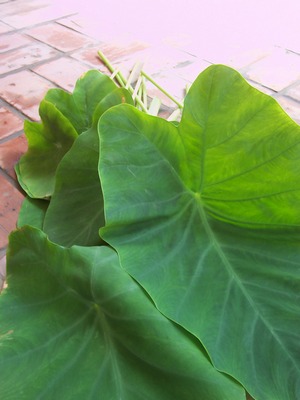
 This Cuisine or recipe requires a leafy vegetable called Arbi patta in hindi and taro leaves or colocasia leaves in english. It looks like one in the above pic. It is a long greeny leafy vegetable which is then marinated and stuffed with paste and then rolled and cut into pieces and deep fried.
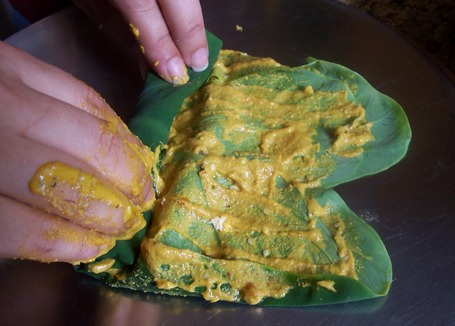
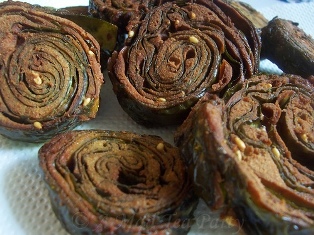
 The masala paste which is prepared is stuffed in the leaf by spreading on it like the one in above pic. Then it is rolled (the way shown in pic) tightly and tied together and baked in steam . Later the baked stuff is cut and deep fried into bhajias.
 Patra Bhajia is a well known and delicious cuisine from Gujrat. Patra bhajias are prepared in Maharashtra too, but known by the name of Aloo wadi. It is spicy and is tempting , one should definately try this out. The only difficult part is spreading or stuffing the paste but it too becomes easier if done carefully.
Ingredients:
15-20 large patra leaves (colocasia leaves)
1/2 cup tamarind extract (juice)
1 cup gramflour (besan)
3 tsp. chilli powder
1/2 tsp. turmeric powder
3-4 pinches asafoetida
1 tsp. crushed cumin seeds
3 tsp. powdered sugar
1 tbsp. oil
salt to taste.
For seasoning:
1 tbsp. oil
1/2 tsp. each cumin & mustard seeds
1 tsp. sesame seeds
1 tsbp. coriander leaves finely chopped
1 tbsp. coconut grated fine.
For deep fry:
Oil 3-4 cups.
Method:
- Clean, wash and wipe leaves. Cut thick veins with a pair of scissors.
- Roll lightly with a rolling pin. Keep aside.
- Mix all ingredients (not those for seasoning).
- The mixture should be a thick paste.
- Place a leaf backside up on a flat work surface.
- Take a little paste and apply thinly all over leaf surface.
- Place another leaf over it. Repeat.
- Get a set of 3-4 layered leaves, top layer being that of paste.
- Fold in the edges and roll the leaves, starting with their base towards tip.
- Make the roll tight and seal sides with some paste.
- Place in the perforated vessel of a double boiler or steam cooker.
- Repeat for all the leaves and paste.
- Steam in the cooker for 30-40 minutes till cooked.
- Cool, and remove. Cut into 1/2" thick slices.
- When cooled well, season as follows.
- Heat oil, add seeds, allow to splutter.
- Add sesame, coriander, and coconut.
- Check and adjust, salt, chilli and sugar as desired.
- Mix well, serve hot or cold.
Making Time: 40 minutes.
Serves: 24-26 patras approximately.
Shelflife: Seasoned 1 day and if deep fried 2-3 days.
Note: The patras can also be deep friend once its steamed and cut into pieces. It taste even more delicious when fried.

 Bhel puri is a street food popularly called as "chaat food". It is a puffed rice dish mixed with some common veggies like mashed potatoes, chopped tomatoes , onions and some tangy chutneys like tamarind chutney and mint chutney. One can see Bhel puri on the streets of Mumbai and for those who want to catch a glimpse of how popular this food is , then just look at the popular mumbai spots like juhu beach, chowpaty where lots of people simply love eating them during evening time.
 Bhel puri is prepared all over India these days but the name differs from place to place. It is called Churu Muri is Bangalore, Jhaal Muri in Kolkata and so on. The other types of chaat that are famous are paani puri, sev puri dahi puri and so on.









 Posts
Posts


