Photobucket
Showing posts with label Indian Snacks. Show all posts
●๋•∂нαηαѕняєє●๋•

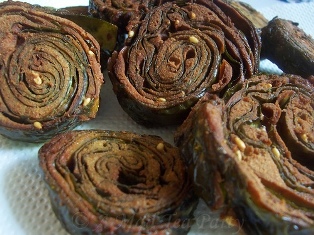
South Indians must be very well aware of this savory called Kai Chuttu Murukku. Murukku is called chakli in western Indian languages . The word "Kai Chuttu" means prepared using hands. Usually murukku is prepared using a press container which gives it the specific shape and design and it is later fried in oil, but in this murukku it's different. Instead of container , hands are used to give them the design and shape and later it is deep fried in oil.
There is something very special about this murukku which I had noted, may be people may find it ridiculous but it's completely my opinion. Just use the same ingredients and use a press container to make murukku . Similarly prepare some murukku using your hands. Taste both the both , I bet you will find a difference in the taste. The one which is prepared using hands are more tastier than those which are prepared using the press container. I can bet on that. Hands definitely gives more taste and make the savory intresting. Once I had a talk on this with a reputed cook specialist in South Indian cuisine, even he was of the same opinion. He said that hands definitely adds a unique taste to the dishes, that's the reason why traditionally prepared cuisines are more famous and liked by people than those which are available ready made in market. It's not just a belief but scientifically too hands can change and make dishes delicious. That's how the saying came where women with good cooking skills are often praised saying they have magic in their hands when it comes to cooking.
Kai chuttu Murukku is item which is always found in most Tamilan household , since it's a Tamil Nadu Savory. Marraiges are often described incomplete unless guests are gifted with a bag containing Kai chuttu Murukku, Beetal leaves, supari, flowers and a sweet dish.
Murukku is prepared in lines(the circles or the rings) depending on the functions. Like this murukku is a three ring which I prepared at home. For marraiges 5 ring Murukku is prepared and 4 ring is prepared during festive seasons.
I love this murukku and make it a point to prepare this at home since I find that more economical and hygienic. I did record the method of preparing the murukku but my video turned out to be too blurred. I will definitely upload the next time i prepare this. As of now I am posting a video link I found on youtube.
http://www.youtube.com/watch?v=1mJnY8C1Rbo
This Lady Vijayakumari has shown the easy way of preparing the murukku which will definately help you guys to understand .
Often kai chuttu Murukku is considered difficult to prepare but believe me , it's not that tough either. All you need is some expertise and patience. Practice everyday and you will be able to prepare it 5-6 days. Don't make dough and waste it for practicing, just make a rough handful of dough out of rice flour and try.
I would recommend a home made flour instead of readymade flour from market. Since home made flour would be best and the results would be far better.


Ingredients:
Rice Flour - 8 cups (read the method below for preparing the rice flour for Murukku).
Urad dal flour - 1 cup
Butter - 100-150 grams
Sesame Seeds - 2 tablespoons
Salt - to taste
Oil for deep frying (probably Palm Oil)


Method: (For Rice Flour)
  1. Take 8 cups of rice (Pachcha arasi/ Kachcha chawal/raw rice) and wash it. Soak it in water for some 10 minutes.
  2. Drain the excess water from the rice.
  3. Take a big clean cotton cloth or a clean towel. Spread it on the floor or a platform or table.
  4. Spread the rice over the cloth and let it dry.
  5. Don't let the rice dry completely. Once the water is completely soaked by the cloth remove it a vessel. You can take a check here. Just rotate your hands on the rice, if it doesn't stick then its ready for making flour.
  6. Grind the rice to a fine powder.
  7. Use a seive (chalni) and pass the rice flour through them to ensure that flour is too fine and not coarse.
  8. The rice flour is ready for Murukku.

Method: (For Urad dal flour)
  1. Take 1 cup of urad and fry it over low flame till it changes it's color . Don't let it get brown. Just roast it till it turns yellowish.
  2. Now cool the urad and grind it to a fine powder.
  3. Pass it through a seive to ensure that you get a fine powder.
  4. Remember: Use only fine flour or else it might crack up while being deep friend in oil and at times it might pop out and might hurt you too.
Method : (For Making Murukku)
  1. Take all the ingredients( except oil) and mix well.
  2. Add some water to it and kneed it into a very soft dough. The dough should be extremely soft.
  3. Take a clean cloth and spread it over a table.
  4. Take some amount of dough in your hands and twist it in between your fingers and make rings in circular path to make the murukku ( watch the video link given above).
  5. Keep twisting the dough in between your fingers and it will make a way out on the cloth. This might take some practice but worth the result.
  6. Heat the oil. When it is ready check if it is ready for the murukku to be fried. For that just drop in a very tiny piece of the dough into the hot oil. If it is ready, it will float and will have foams around indicating its ready. In other words , you can see it being fried.
  7. Now it is time to fry the murukku.
  8. Carefully lift the cloth with one hand and flap the part where the murukku is prepared in your hands.
  9. Slowly and carefully drop the murukku in hot oil one by one.
  10. In case where you are not sure about it, then you can prepare the murukku in the spatula and then place in the hot oil till it starts seperating from the spatula.
  11. Similarly drop in the other murukku one by one and deep fry it till it turns golden brown .
  12. Allow it to cool and store it a airtight container. This can be stored up to 2 months if stored preperly.
  13. Kai chuttu Murukku is ready.


Preparation Time: 4 hours
Cooking Time: 1 hour
Serves : Makes almost 100- 120 Murukku
Shelflife: 2 months
Serving Suggestion: A good evening snack.


Note:
  • Always use home made flour, it might take time but its worth the result.
  • Pass it through seive properly to ensure that you get fine flour.
  • Practice and you would definitely perfect the art of making chuttu murukku.
  • Use desi butter which is available in markets as if would really give a better taste to the savory.


Click here to know all about Tamil Nadu cuisines- Introduction To Tamil Nadu Cuisines And Recipes.


sign
●๋•∂нαηαѕняєє●๋•
Shakara Varatti is a special chips prepared in kerala. It is unique in taste and can be found in almost every Malayali household. This chips has the meaning and the description of its name in the name itself. Shakara varatti is a Malayalam word (language spoken by people of Kerala). Shakara means sweet and varatti means coated. Yeah right, this chips is sweet in taste and it is coated in jaggery which gives it this unique taste , hence it has this name.

I have few malayali family friends and also i have few malayali friends while i was in college and i had a good opportunity to taste and explore their food and recipes. Kerala recipes are quite simple and not much complicated to prepare. Kerala being a coastal state , malayalis use things which are commonly and easily available in abundance over there. Being a coastal area, it is abundant in coconut trees, banana tree , rice , fish and ground vegetables. That being a reason, you can see many keralities using coconut and coconut oil for cooking. Coconut oil is believed to have many health benefits and beauty benefits. Well let me come to the recipe. Its a delicious recipe which almost tastes like a traditional candy. It requires less ingredients but needs good concentration of mind and little patience for preparing this recipe. But the secret of making any recipe delicious is just prepare with love and affection and serve it much love and affection even the worst made food would taste delicious.

So, here am posting the shakarra varatti recipe, i cant post the preparation pics though since most of the pics turned out to be blurred and had bad quality of light. But i will surely make it a point to prepare this once again when i get time and post the pics on this blog. As of now, I am elaborately explaining the method of preparing this recipe. This was the first time i prepared this, but am satisfied with the outcome so hope it would help those who read it too.


Ingredients:
Unripe plantains(Raw Bananas) - 1 kg (it usually counts to 5 bananas)
Jaggery( - 300 gm
Cardamom( - 5 nos
Dry ginger and cumin seeds powder - 1 tbsp (add just 2-3 pinches of cumins to make powder)
Coconut oil - 250 gm
Ghee - 1 tbsp
Sour curd - 1/2 glass .


Method:
  1. Peel the skin of the plantains(Raw bananas).
  2. Slit the banana lengthwise and cut it into 1/4" pieces.
  3. Put them in warm water for few minutes , say some 10-15 mins.
  4. Take enough water to cover the plantain pieces.
  5. Pour sour curd into this water to get rid of the plantains’ serum. Usually raw plantains are sticky and this makes it uneasy to use . This white sticky thing which looks like serum makes the pieces cling to each other thus making it imperfect. Sour curd washes away those sticky serums thus giving you clean pieces of plantains for chip which stays seperated from each other.
  6. Keep this aside like this for some 30-40 mins. So that the sour curd removes away those sticky serums completely. It won't change the taste anyhow nor would the chips would taste sour.
  7. Now strain the excess water off.
  8. Now take a clean piece of cloth (water absorbale cloth) and pat dry the plantains. So that oil won't throw some boiling sparks on you while frying them.
  9. Heat oil in a deep bottomed vessel . Let it heat for sometime and then lower the flame as this would make the chips crisper.
  10. Put the plantains pieces in the oil . Put in batches so that it is fried nicely.
  11. Keep a check on them continuously by stirring in between so that it doesn't get sticked to each other.
  12. Cook in medium to low fire until the pieces start turning brown. Allow them to cook and fry them properly so that chips are crispy. It will take some time. (Here is a nice tip to know that the chips are fried. When the foams around the chips in hot oil are reduced, its a indication that its well friend and cooked but also be careful not the let them change the color to dark brown).
  13. Once the chips are fried remove the pieces from the oil using a strainer and put them in a tissue paper to absorb excess oil.
  14. Dissolve jaggery in water and bring this to a boil.
  15. When the boil settles down and the mixture becomes thick.
  16. Add the plantains into the boiling jaggery one by one .
  17. The consistency is right if you see thin jaggery threads forming while you stir the plantain pieces.
  18. Add powdered cardamom and dry ginger-cumin powder and mix well. So that the spices gets coated on each chip pieces.Also add ghee and mix well.
  19. Now the nicely coated coated jaggery pieces could be seen visibly seperated and turning dry. (In case, it doesn't look completely dry then add 2-3 tablespoons of fine sugar to this and stir well).
  20. Shakara varatti is ready. Allow it to cool down and then store them in a air-tight container. It remains for 1 month if stored properly.


Preparation Time: 1 hour and 30 minutes
Cooking Time: 1 hour
Shelflife: 1 -2 months if stored in air-tight container
Serves: Can be easily served to 20-15 persons
Serving Suggestions: Serve as a evening snack or serve it with lunch.


Note:
  • Don't ever fry the chips directly in the oil. Do soak them in the sour curd for atleast 30 mins.
  • For safety reasons especially beginners, do pat the chips in a dry clean cloth after removing from water and then fry them in oil so that boiling oil doesn't harm you.
  • Keep stirring occasionally while frying, so that the chips doesn't stick to each other.
  • When the foams around the chips in hot oil are reduced, its a indication that its well friend and cooked but also be careful not the let them change the color to dark brown.
  • The jaggery is important part of this recipe. The consistency is right if you see thin jaggery threads forming while you stir the plantain pieces.
  • In case, it doesn't look completely dry then add 2-3 tablespoons of fine sugar to this and stir well. This would let it dry and make perfect chips


Click here to know more about Kerala recipes and cuisines - An Introduction to Kerala Recipes and Cuisines.


Click here to know more about Indian sweets and desserts - An Introduction to Indian Sweets And Indian Desserts.

sign
●๋•∂нαηαѕняєє●๋•
Many South Indians must have heard about this salty evening snack called sundal. This is especially popular in the beaches of TamilNadu and Andhra. Considered a healthy and good evening snack, this is simply easy to prepare. Sundal is also prepared on the special occassion of Navrathri, where it is a ritual in India to offer Naivaidya to the goddess during the 9 days of the festival. This sundal is highly recommended by many tamilians who practice this ritual and also keep the traditon of Gollu at home ( a preparation where idols of gods and goddess is decorated in a staircase like structure and prayed during the navrathri). In southern coastal areas, coconut is basic ingredient in most of the cuisines be it daily food, snacks or breakfast. It is consumed in all ways be it coconut, milk, grated coconut or as paste.

A interesting fact is that coconut is though considered hard to digest by many people, it is highly good for skin and hair. Keralities swear by coconut and its evident of its benefits from their good skin and dark long thick hairs.
Ingredients:
Chick peas - 2 cups
Mustard seeds - 1/2 teaspoon
Cumin seeds (optional) - 1/2 teaspoon
Asafoetida (hing) - 1 pinch or 1/4 teaspoon
Curry leaves - 10-12 nos
Dry red chillies - 2-3 nos
Grated coconut or dessicated coconut - 1/2 cup
Salt - to taste.


Method:
  1. Soak the yellow peas the previous night for about 6-8 hours. If you plan to make it for an evening snack, it is enough if you soak it that morning.
  2. Drain all the water and pressure cook with a little salt and just enough water that they just reach the top of the peas.
  3. Do not add too much that the peas drown in the water. This will render them mushy.
  4. Switch off after 2 whistles and open after pressure is released.
  5. In a kadai, add a spoon of coconut oil and when it is hot, add mustard, curry leaves and a dash of hing.
  6. Immediately add the cooked yellow peas and a little salt.
  7. Garnish with coconut and stir well for a minute.
  8. Remove and serve hot as a evening snack or as neivaidyam on festive occassions.

Preparation Time: 20 minutes (excluding soaking time)
Cooking Time: 10 minutes
Serves: 4 persons
Shelflife: 1 day
Serving Suggestions: Serve hot with evening tea or coffee.


Variation:
A small variation can be done in sundal as it can noticed in marina beach where during the mango season, hawkers add finely chopped pieces of raw mango (kachchi ambi/ manga) to this sundal for a tangy taste.


Note:
  • Sundal can be prepared with Dark Kabuli channa too.
  • Sundal preparation vary from place to place as per taste. Like some people add chopped ginger to this and some avoid coconut since they find it hard to digest. This one is basic sundal prepared the same way by almost many people.


Click here to know all about Tamil Nadu cuisines- Introduction To Tamil Nadu Cuisines And Recipes


sign
●๋•∂нαηαѕняєє●๋•
Indian vermicelli is delicacy which is quiet tasty and delicious. Vermicelli is widely used in many indian recipes like kheer, pulao and upmas. I had already posted few recipes with vermicelli as its main ingredient.
Many people tend to have a opinion on vermicelli that it might not be intresting stuff to eat especially childrens. Even i was one of them. As a child i always used to find vermicelli also called semiya as a boring food and would run away at the mention of it. I still remember how maa used to run after me asking to atleast taste it and i would give her a good chase making her angry and tired. Now that i am grown up girl who is incharge of kitchen and everyone's health at home, its now that i realise the pain she would to take while cooking in the kitchen. Love you maa.

This food which i used to find damn boring as a kid is one of my favourite as a grown up girl. And now though i am grown up and cook them very well yet when it comes to my favourite food, i ask my maa to cook for me instead , i simply love the cook when she cooks for me. It is rightly said in hindi that "maa ke haath ke khane mein jaadu hota hai", i completely agree with it.

This recipe is a south Indian (Tamil Nadu) recipe and is a healthy breakfast . Adding vegetable adds a good taste to this recipe and makes it look delightful to the eyes of kids who run away from food. As such this recipe doest need any side dish and can be served alone which adds a good factor. It is quiet interesting to cook and more interesting to serve them. Also this can be counted as a good evening snack and also for a good party menu .

The vegetables which can be added to vegetable upma are similar to those of Pulav. And the amount of vegetables can be adjusted as per one's choice and love for veggies. I prefer more veggies since i believe in having more veggies to my diet for a good health and balance. So the vegetables that can be added are carrots, peas, potatoes and cauliflower . Even cashewnuts can be added to make it intresting . Besides that a good thadka gives a excellent taste to vegetable Upma.


Ingredients:
Vermicelli - 1 packet ( available ready made in market)
Oil - 1 tablespoon
Mustard seeds - 1 teaspoon
Curry leaves - 1 string or 10-12 leaves
Onion - 1 medium, finely chopped.
Carrots - 2 carrots, cut into thick jullinne or big strips
Peas - 1/2 cup (soaked overnight for atleast 6 hours)
Potatoes - 2 potatoes, cut into thick jullinne or big strips
Cauliflower - 1/2 cup (optional), cut into tiny florets
Grated Coconut - 2 tablespoons.
Vanaspati or desi ghee - 1 tablespoon
Salt - to taste.


Method:
  1. Take a kadai and roast the vermicelli till it changes its colour to light pink . Dont allow it to turn brown, just roast it enough that it changes the colour. Roasting makes the vermicelli softer and tastier. These days readymade roasted vermicellis are easily available in market, even those can be used instead of roasting them also it costs just 2 rupees more then the ordinary ones.
  2. Remove the roasted Vermicelli is a plate and allow it to cool.
  3. Take a deep bottomed kadai and keep it on flame.
  4. Add a tablespoon of oil to it . Add the mustard seeds and allow it to crackle.
  5. Once the mustard seeds crackle, add the chopped onions and saute them till it turn translucent or pinkish in colour.
  6. Now add the curry leaves and saute it for a minute.
  7. Once this initial thadka is ready, add 3 cups of water in the kadai and allow it to boil.
  8. When it boils, add the chopped vegetables and salt and stir well. Close the kadai with a lid and allow it to cook for sometime till the vegetable become tender soft and gets cooked well.
  9. After some 10 minutes, check the vegetables, they must be ready by now.
  10. Add vanaspati or ghee and stir once again. Add the vanaspati or ghee at this stage since, it gives a fresh taste and aroma to the upma and thus making it delicious.
  11. Now add the roasted vermicelli to the kadai and keep stiring it nicely till the vermicelli gets cooked and turns soft. Also see that the water gets absorbed as the upma gets ready.
  12. When the water gets absorbed completely and the vermicelli is soft and cooked, remove it and keep aside.
  13. Vegetable Vermicelli Upma is ready to serve.


Preparation Time: 30 minutes.
Cooking Time: 20 minutes.
Serves: 4 persons.
Shelflife: Best fresh.
Serving Suggestion: Serve hot as breakfast or as evening snack.


Note:

  • Vegeables can be added as per choice and likings.
  • Even cashewnuts can be added in this upma along with the veggies and allow them to get cooked in the water along with it.


Click here to know all about Tamil Nadu cuisines- Introduction To Tamil Nadu Cuisines And Recipes.
sign
●๋•∂нαηαѕняєє●๋•
Bhel puri is a street food popularly called as "chaat food". It is a puffed rice dish mixed with some common veggies like mashed potatoes, chopped tomatoes , onions and some tangy chutneys like tamarind chutney and mint chutney. One can see Bhel puri on the streets of Mumbai and for those who want to catch a glimpse of how popular this food is , then just look at the popular mumbai spots like juhu beach, chowpaty where lots of people simply love eating them during evening time.


Bhel puri is prepared all over India these days but the name differs from place to place. It is called Churu Muri is Bangalore, Jhaal Muri in Kolkata and so on. The other types of chaat that are famous are paani puri, sev puri dahi puri and so on.
Bhelpuri was originally a Gujarati food. It later got merged with Mumbai culture and became synonymous with Mumbai. Bhelpuri is best consumed as soon as it is made. If left for a while, the juices from the tomatoes, chutneys, etc. combine to render the sev and mamra soggy.

Though these days Bhelpuri has many variations like chana bhel, chinese bhel , diet bhel, kurkuri bhel, dry bhel and many such bhels. The basic Bhelpuri is made from puffed rice, sev (a fried snack shaped like thin noodles made from besan flour) , some friend snacks, and veggies like finely chopped onions, tomatoes, chillies, Coriander leaves( for garnishing), boiled and mashed potatoes along with different kinds of chutney to add sweet, tangy and spicy flavour like tamarind chutney and mint chutney. Different chutneys impart a sweet or spicy flavour. There are two popular chutneys used, a dark purple sweet one made mainly of dates and tamarind, and a green spicy chutney made of coriander leaves and green chilis.

Another variation is to sprinkle the chat with chunks of diced sweet mango.Even raw mangoes goes excellent in bhelpuri if chopped finely. The finished snack is often garnished with a combination of diced onions, coriander leaves and chopped green chilis. It is sometimes served with papri puris, a deep fried small round and crispy wheat bread. The result is a sour/pungent/sweet tasting evening snack that is a treat for the tastebuds and a good source of carbohydrates and minerals. Some people add cucumber, and other veggies of their choice as per preference in these days.

Over all, bhel puri is a excellent evening snack , a quick to make recipe and nice to treat the evening hunger. Modern versions of bhelpuri includes, dry bhel, chana bhel, chinese bhel etc where ingredients are adjusted as per one's taste and preference keeping in mind the diet and taste of person. But nothing can ever beat the original Bhelpuri . It is just perfect indian snack. A snack with almost iconic status in Western India, bhelpuri is low-fat, nutritious and delicious!


Ingredients:
1 cup Puffed Rice (Kurmura)
1/2 cup chopped Tomato (Tamatar)
1/2 cup chopped Onion (Pyaj)
1/4 cup chopped Coriander Leaves (Dhania Patta)
1/2 cup boiled and mashed Potato (Aloo)
4 chopped Green Chilli (Hari mirch)
1 tblsp Garam Masala or Red chilli powder (use red chilli powder mostly)
1/4 teaspoon Turmeric powder
6 tblsp Tamarind (Imli) Chutney
6 tblsp Coriander Leaves (Dhania Patta) And Mint Chutney
1/2 cup Nimkis
1/2 cup Sev
1/2 cup Gol gappas
2 tblsp Lime or Lemon (Nimbu) Juice
1/2 cucumber grated (optional)
1 carrot grated (optional)


For Garnishing:
1/2 cup sev
5-6 papdis
2 tablespoon Chopped coriander leaves
1 tablespoon Chaat Masala


For Green Chutney:
Coriander leaves / Cilantro - 1/2 bunch
Green chillies - 6 nos
Potato wafers - 1 tablespoon (optional- just to give some thickness)
Salt - as per taste
Lemon juice - 1/2 tablespoon


For Tamarind Chutney (Sweet and Sour Chutney):
Tamaraind Extract - 1 cup
Pitted Dates - 1 /2 cup
Brown sugar - 1 tablespoon
Black salt - 2 pinches or 1/4 teaspoon
Cumin powder - 2 teaspoons
Red chilli powder - 2 teaspoons
Salt - As per taste.


Method:
  1. Blend all the ingredients of Green chutney and make a fine paste of it. Reserve and keep aside.
  2. Take together all the ingredients of Tamarind chutney and boil them in a deep bottom vessel till it is reduced to half. Remove from fire and allow it to cool. Grind it to make a smooth consistency of it and keep aside.
  3. Chop the onions, tomaotoes and chillies finely and keep aside. Cumcumber and carrots are optional. Grate them and keep aside. As such the original bhel puri recipe doesnt include carrots and cucumber but some add for added taste or for garnishing. Even finely chopped raw mangoes or kairi adds good taste to bhel puri.
  4. Take a deep bottomed large vessel so that it becomes easy to mix the ingredients .
  5. Put the chopped onions, tomatoes, chillies and puffed rice in the vessel. Mix them properly. Add the mashed potatoes and mix them.
  6. Now add the powders like red chilli powder, salt, turmeric powder and mix them well.
  7. Now add the chutneys like tamarind chutney and mint chutney and mix well. The bhel should get coated with the chutney and look reddish orange in colour.
  8. Now crush the golgappas and few papdis and add them to the bhel. Also add the coriander leaves, sev and sprinkle some lemon juice and mix well.
  9. Bhel puri is ready to eat. Take a wide plate and put the bhel puri on the plate and garnish it with sev, chopped coriander leaves . Sprinkle little chaat masala on top and place a spoon in the middle of bhelpuri. Do serve this immediately or else the puffed rice would eat up lot of moisture and loose its puffiness.
  10. Enjoy the spicy tangy bhelpuri .


Preparation Time : 20 minutes
Making time: 10 minutes
Serves: 4 persons
Shelflife: Best fresh
Serving suggestion: Serve them fresh immediately after preparing toppled with good garnishing.


Note:
  • Chop the onions and tomatoes finely.
  • You can skip the chillies in case if you dont like it.
  • Add 1 tablespoon og tomato ketchup to the bhel while adding the chutney and mix. It gives added taste to the bhelpuri
  • If you dont have papdis and golgappas, then crush some Khari and add. It gives the same crunchiness and taste to bhelpuri.
  • Sprinkling some chaat masala adds a extra taste to bhelpuri. Some add a pinch of black salt too. Even that gives a good taste.


sign
●๋•∂нαηαѕняєє●๋•

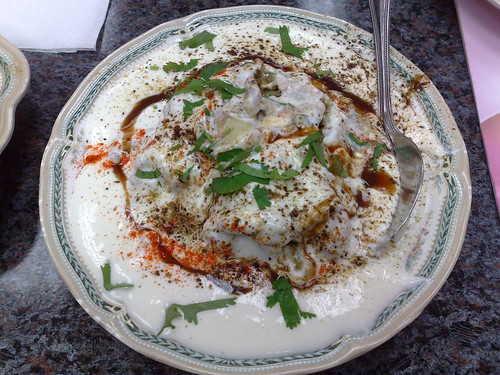
Dahi bhalla also called as Dahi bhalle is a popular street food which is normally counted among "chaat". Dahi Bhalla is often a special food during the Holi festival too. Dahi bhalle is made of dal pakodas and tangy yoghurt and garnished with tangy and sweet chutneys. This can be widely seen in the streets of big and small cities. Dahi Bhalle is wadas dunked in loads of chilled and seasoned curds and then topped with tamarind chutney and spices. Though usually, dahi bhallas are tastier at the roadside vendor's shop, it is not that possible to bring that yummy taste at home but it can be made at par with them by using roasted cummin powder, chat masala, black salt , tamarind chutney and red chilli powder. I have tasted different variation of this. Some like their curds to be sweet, others like it salty. The Gujarati version has a sweet and spicy flavor and uses liberal amounts of curds. The Punjabi version is salty and the wadas are just submerged in the curds but not floating in it. The dahi wada that I've tasted in Udipi cafes has tempered sweet curds. But for a good yummy taste, it is best to mix up and prepare.


Ingredients:
For The Bhalla:
1 cup Black gram, split (dhuli urad dal)
2 cups (500 ml) Water
1/2 tsp Salt
1 tsp ( Cumin (jeera) seeds
2 tsp ( Ginger (adrak), chopped
1 tsp Green chillies, chopped
1 1/4 cups (250 ml) Vegetable oil.


For The Dahi:
2 cups ( Yoghurt (dahi), thick, whisked
1 tsp Sugar
1/2 tsp Salt
1 tsp Cumin seeds, roasted, pounded
1/2 tsp Black salt (kala namak)
1/2 tsp White pepper (safed mirch) powder.


For The Garnishings:
1 tsp Ginger, julienned
1 tsp Green chillies, julienned
1 tbsp coriander (hara dhaniya), chopped
a pinch Red chilli powder
a pinch Cumin seeds, roasted, pounded
4 sprigs Mint (pudina) leaves
3 tbsp Tamarind chutney (sonth)


Method:
  1. For the bhalla, clean the black gram and soak in water for 2 hours. Drain and grind to a fine paste, adding very little water.
  2. Remove to a mixing bowl and add salt, cumin seeds, ginger, and green chillies. Mix well and shape into even-sized balls.
  3. Heat the oil in a wok (kadhai).
  4. Add the prepared balls, a few at a time, and deep fry till golden brown, (Make a hole in the centre of the ball with the thumb just before frying.)
  5. Remove and drain the excess oil on absorbent paper towels.
  6. Soak the prepared bhalla in lukewarm water till soft.
  7. For the yoghurt mixture, add all the ingredients and mix well.
  8. Remove the bhalla from water, squeeze out excess water and add to the yoghurt mixture. Keep aside for 10 - 15 minutes.
  9. Serve chilled, garnished with ginger, green chillies, green coriander, red chilli powder, cumin powder, mint leaves, and tamarind chutney .


Preparation time: 20 minutes (excluding soaking time).
Cooking time : 30 minutes.
Serves : 4 persons. Makes some 8- 12 wadas.
Shelflife : Best fresh.
Serving suggestion : Serve with chilled dahi and garnishings.


Other Method:
  • Make the batter little thin. But not very watter, just enough to be fluffy. Then pour it into hot oil using a spoon and deep fry it till golden brown.


Note:
  • Cooking soda can be added to make the wadas spongy and crispy.
  • Freeze the wadas for sometime for better taste.
  • Use roasted cummin powder for garnishing.


Click
here to know more about Punjabi Foods and Cuisines - An Introduction To Punjabi Foods And Cuisines.
●๋•∂нαηαѕняєє●๋•

Methi Pakora , one more greens to my list of recipes in the blog. But this one is a snack, unlike the others which were side dishes or main course. Methi (Fenugreek leaves) is a full of medicinal properties. Methi has good benefits for diabetic patients, nursing mothers and for those who want to reduce cholestrol. This is a wonder herb popular in India, rich in protein, calcium, phosperous and iron in its natural form. Its mineral and vitamin content is also very high and is easily assimilated by our body. The fibre content in Methi is effective in stabilizing blood sugar levels by just having 1/2 cup of methi leaves daily or a spoon of methi seeds with milk taken an hour before meals. Methi is cooked in various form in India be it main course, side dish or a quick to eat snack. Methi pakoras are one such snacks, and it is a good source of food. Methi pakora is simple to prepare and easy to digest. I hope this recipe would be liked and enjoyed.


Ingredients:
1 cup chopped methi leaves (Fenugreek leaves)
2 chopped onions
1 teaspoon Turmeric powder
1/2 teaspoon Red chilli powder
2 cups Besan (Gram flour)
1 teaspoon Amchur powder (Dry Mango powder)
Salt to taste
3 cups oil for frying.


Method:
  1. Add water to besan and make thick batter. Add the water in small amounts to avoid forming of lumps.
  2. Add chopped methi leaves, chopped onions,turmeric powder, red chili powder, and mango powder and salt to the besan batter and make a mixture.
  3. Heat the oil.
  4. Fry small portions of this mixture in oil till they turn brown. You can take the portions with the help of your hands or with spoon.
  5. Serve hot with green chutney.


Preparation Time: 10 minutes.
Cooking Time: 20 minutes.
Serves: 4 persons.
Shelflife: Best fresh.
Serving suggestion: Serve hot with green chutney.


Note:
  • Add water in small amount to avoid forming of lumps.
  • The amount of red chilli powder can be adjusted as per taste.


Click here to know more about Punjabi Foods and Cuisines - An Introduction To Punjabi Foods And Cuisines.
●๋•∂нαηαѕняєє●๋•

Its monsoons and everyone of us would love to sit at home nearby the windows or at balcony and enjoy garam garam pakoras and enjoy watching the rains in a chilly wet evening. Pakoras are favourite among every indian, being young or old. And everyone loves to have them during monsoons. Punjabi style pakoras are known for their crispy and spicy taste. There are varieties of pakoras like Aloo pakoras, Gobi pakoras, Palak pakoras etc. One such pakoras is Paneer pakora, which is just tempting during chilled evenings. Paneer Pakoras is a well known snack from Punjab and I thought of posting this now since the period of monsoons are just perfect to share this recipe and enjoy them.


Ingredients:
250 grams Paneer (Cottage cheese)
8 tablespoons Gram flour (Besan)
2 tablespoons Corn flour or Rice flour
2 tablespoons Red chilli powder
1 1/2 tablespoons Amchur powder (Dry mango powder)
1 pinch Ajwain (Carom seeds)
1 pinch Hing (Asafoetida)
1/4 teaspoon Cooking soda
Water as per requirement
Oil for frying.


Method:
  1. Firstly cut the cheese into thick square pieces.Cut them in size of 3 inches wide and 2 inches broad and height of atleat 1 inch.
  2. Sprinkle mango powder and red chilli powder on these pieces.
  3. Mix the gram flour,rice or corn flour, red chilli powder,amchur powder, hing, ajwain, soda and salt in a bowl.
  4. Add some water to the mixture to make it thick batter.Dont add more water at a start. Add part by part in small quantity to avoid forming lumps , this helps in making smooth batter. Add water only to the consistency to make the batter smooth . Dont add too much of water and end up making its consistency too thin.
  5. Dip each piece of the cheese in this batter.
  6. Heat the oil in a frying pan.
  7. Check whether the oil is hot enough. This can be checked by dropping few drops of the batter into the oil. If it is hot enough to fry the pakoras, then you can see those batter coming up and bubbles surrounding them indicating its ready for frying the pakoras.
  8. Now put the pieces of cheese in the heated oil one by one.
  9. Fry them till they become golden brown.
  10. Remove them in a Oil absorbent paper or place a tissue paper at the top of the plate where the pakoras would taken out.
  11. Paneer Pakoras are ready.
  12. Serve the Paneer Pakoras with green chutney or with tomato ketchup.


Preparation time: 10 minutes
Cooking time: 20 minutes
Serves: 4 persons
Shelflife: Best fresh
Serving suggestion: Serve hot with green chutney or tomato ketchup.


Note:
  • Normally, rice or corn flour is not added to the batter. But adding 2tablespoons of corn or rice flour would make the pakoras crispy and crunchy.
  • Amchur powder is added to give a tangy taste .
  • Sprinkle a pinch of chat masala over the paneer pakoras while serving. It makes them even more tastier.

Click here to know more about Punjabi Foods and Cuisines - An Introduction To Punjabi Foods And Cuisines.
●๋•∂нαηαѕняєє●๋•
Mathi is a crunchy and crispy biscuit from Rajasthan. It looks very simple and is also very simple in cooking. It is prepared from flour and ghee and is usually served at tea time. It can be preserved for 2-3 days since it has no other ingredients added in it nor any spices . It is very good to eat though it is very simple and can be a good snack during chilled seasons.
Ingredients:
400 gms Flour
100 gms Desi ghee
Salt to taste
Oil for frying.
Method:
  1. Add ghee and salt to flour and mix it well.
  2. Add water and make dough till it turns smooth.
  3. Cut it into pieces and roll out it to make small and thick discs .
  4. Heat the oil and fry each disc till it turns golden brown.
  5. Serve it with pickle.

Making Time: 15 minutes

Serves: 4 persons

Shelflife: 2 days.

Note: To preserve it for more than 1 day, store it in air-tight container.

Click here to know more about Rajasthani foods and cuisines - Introduction to Rajasthani Foods And Cuisines.

●๋•∂нαηαѕняєє●๋•
Huge varieties of chillies ( mirchi) are found in Rajasthan. An eight inch long variety is split open and filled with potato and masala and fried in besan to make this yummy vadas.

This recipe needs chillies which are long , less spicy and bigger in size. So choose the chillies like the one above, which is light green, long and little bigger than normal chillies available in market.


India id known for for spicy foods. Thus chillies are must in every indian recipe. Chillies are used not used for adding spiceness to food but it is also used as main ingredients in many recipes. Mirchi vadas are one such popular snack from eastern regions of Rajasthan and Maharashtra. But it is widely prepared in Rajasthan. The main ingredient Mirchi should be choosen correctly for this recipe. There are varieties of chillies available in market. So the chilli which is not spicy should be choosen . Choose the one which is long like banana and is bigger is size, those chillies are not much spicy and it is perfect for making the vadas owing to it size and other features (see the above pic for chilli, the top one).


Ingredients:
Long Banana size chillies -6 nos


For Batter:
Gram flour - 1 cup
Turmeric powder (haldi) -2 pinches.
Salt to taste
Water as required.


For Filling:
Potatoes - 3 large ones
Red chilli powder - 1 tbsp
Coriander leaves chopped fine - 1/2 tbsp
Salt to taste.


Method:
  1. Slit the peppers, remove seeds and keep aside.
  2. Boil potatoes with salt.
  3. Peel and mash them well.
  4. Add chilly powder and coriander leaves. Mix well.
  5. Make a thick batter with the flour, turmeric powder and salt.
  6. Fill the chillies with the potato mix.
  7. Dip the filled peppers in the batter till they are completely covered.
  8. Fry them in preheated oil till golden brown.
  9. Serve hot with chutney or sauce.

Making Time: 20 minutes
Serves: 4 persons
Shelflife: Best Fresh.

Note:
  • Deep fried snacks contains lots of oil, so always transfer them on a absorbent paper before transfering to plates when u take them from oil.
  • If you prefer spicy, then you can keep the seeds while u silt.

Click here to know more about Rajasthani foods and cuisines - Introduction to Rajasthani Foods And Cuisines.

●๋•∂нαηαѕняєє●๋•
This is an aluminium contraption in which handvo - a Gujju snack - is prepared. The cooking contraption, I think, is somewhat like a chiffon cake/ angel food cake pan - a very deep tube. It sits on a plate filled with damp sand to help conduct the heat better. It also has a hole in the middle, where you can see the flame rising from in the image. This hole helps cook the center of the handvo.


Handvo is traditional baked cake from Gujrat. Handvo involves lots of preparing process and work and hence needs to cooked carefully. These days Handvo flour is readily available in markets. But traditionally lentsils and grains are soaked and grinded into paste which is then baked in a special utensil which is especially used for cooking Handvo. The closest I can get to describing the handvo is that it is a savoury cake, chock full of grains and vegetables, spices, some oil, and a bit of soda and buttermilk for leavening. It is topped with sesame and coriander leaves which bake the top to a crisp.
Ingredients:
4 cups handvo mix or
2 cup rice
1/2 cup urad dal
1/2 cup toor dal
1/2 cup yellow split moong dal
1/2 cup chana dal
1 bottle gourd (lauki/dudhi/zucchini)- shredded
5-7 green chilies (as per your spice level)
1 inch piece ginger
3-4 cloves garlic
2 cups yoghurt
1/2 tsp soda-bi carb
salt to taste
sugar to taste .
For Tempering:
3 tbsp oil
1 tsp mustard seeds
1/2 tsp cumin/jeera seeds
1/2 tsp turmeric
1/3 tsp red chili powder
1/4th tsp asafoetida
2 dried red chilies
1 tsp sesame seeds.
For Garnishing:
1 tbsp sesame seeds.
Method:
  1. Soak all the lentils/dal and rice overnight.
  2. Grind the lentil-rice mixture with some water to form a thick batter.
  3. Add the yogurt and leave aside for another 5-6 hours in a warm place.
  4. Alternately if using the ready made handvo mix soak the mixture in yogurt and water overnight in a warm place.
  5. Add the grated bottle gourd, sugar and salt and mix well.
  6. Crush the green chilies, ginger and garlic to a smooth paste and add it to the handvo mixture.
  7. Heat oil, add the mustard and cumin seeds, and when they pop, add the turmeric, asafoetida, chili powder, dried chilies and sesame seeds in that particular order and pour this mixture over the handvo mixture.
  8. Mix well and transfer the batter to a baking pan.
  9. Sprinkle with sesame seeds on top and bake at 400 degree F for 45-60 minutes till the top is a golden brown.
  10. Alternately test by pushing a knife through and if it comes out clean (instead of the batter clinging to it), the handvo is baked.
  11. Serve hot with some oil on the side.
  12. Take out. Cut into squares and serve immediately.

Making Time: 45 minutes

Serves: 4 - 5 persons.

Shelflife: 1 day.

Note:

  • If you are using a oevn, bake for 45 minutes in a preheated oven, 15 minutes at 200 degree centigrade, and 30 minutes at 180 degrees centigrade.
  • If you have doubts regarding the batter consistency or its fluffiness, you can add 1 eno fruit salt to the batter before baking, it would amke the handvo soft.

Variations:

As a variation or to make handvo more nutricious, finley chopped vegetables like carrots, cabbage, potatoes, leeks etc to the batter and mix well and then bake them. Remember to chop them very finely for good texture and good taste.

Click here to know more about Gujrati foods and cuisines- An Introduction To gujrati cuisines and Recipes.


●๋•∂нαηαѕняєє●๋•

Khichu is a well known recipe from gujrat. Khichu is kind of khichdi and is usally served with kadhi and papad.
Ingredients:
1 kg Rice flour
1 tbsp Tamarind pulp
1tsp Ajwain
1/4 cup Water
2 tsp Brown sugar
1 1/2 tbsp Ghee or oil
1/2 tsp mustard seeds or sesame seeds
1/4 tsp soda bi-cab
1/2 tsp Ground turmeric
1/2 tsp Cayenne or ground chili pdr
1 tsp Ground coriander
1 tsp Ground cumin
1 tsp Salt
2 Fresh green chilies, seeded And thinly sliced
2 tbsp Desiccated coconut.
Method:
  1. Blend together green chillies, cumin seeds and ajwain finely and set aside.
  2. In a heavy bottom pan heat water double the quantity of flour .
  3. Add the blended mixture to it.
  4. Add the soda, salt, turmeric powder, sesame seeds ,brown sugar, turmeric pulp, coriander powder and desicated coconut to this water (do not stir).
  5. When the water starts boiling , add the flour to it slowly but do not mix or stir it.
  6. Spread the flour over the water with the help of a spoon and close the vessel with a lid (do not stir or mix).
  7. keep the flame on low.
  8. After some 30 minutes, the flour absorbs all the water and water covers the flour over the top.
  9. Now with the help of a wooden laddle, Stir the mixture in one direction continuously.
  10. Keep stirring and mixing till all the water is absorbed and the flour comes to dough like texture.
  11. Remove from fire and serve hot with kadhi or chutney with papads.

Making Time: 45-50 minutes

Serves: 5-6 persons.

Shelflife: 2 days.

Note: Do not stir when the water is boiled and the flour is added. Do not stir them while cooking untill all the water is absorbed by the flour. After that stir continuously and in one direction to make it soft and smooth.

Click here to know more about Gujrati foods and cuisines- An Introduction To gujrati cuisines and Recipes.

●๋•∂нαηαѕняєє●๋•
Matri is cuisine from Gujrat. There are different types of Matris like namkeen matri, sweet matri, gol matri etc. Matris are very simple and and tastes simple too. Here i am posting a simple matri in the simple method.


Ingredients:
1 cup plain flour
1 tbsp. ghee or oil
salt to taste
2-3 pinches soda bicarb
1/4 tsp. ajwain seeds
warm water for kneading
oil for deep frying.


Method:
  1. Mix all ingredients, except oil for deep frying and water.
  2. Add water little by little kneading into a pliable dough.
  3. Cover and keep for 15 minutes.
  4. Break into small portions, roll in 1" wide rounds.
  5. Keep a little thicker than puris. Prick with a fork.
  6. Place on a clean spread out cloth.
  7. Similarly prepare all the matris (puris) .Finish for all dough.
  8. Heat oil in a frying pan, add some matri at a time.
  9. Fry till lightly golden, flip side and repeat.
  10. Drain and cool to allow to become crisp.
  11. Store in an airtight container.

Making time: 40 minutes

Makes: 25 pieces (approx.)

Shelflife: 2 weeks at room temperature.


Note: Keep on low flame while frying matris. Also turn them carefully, since it tends to break soon due to delicacy.


Click here to know more about Gujrati foods and cuisines- An Introduction To gujrati cuisines and Recipes.
●๋•∂нαηαѕняєє●๋•
Fafda is a savoury from Gujrat. It is popular in gujrat and is prepared from chickpea flour known as besan. It is good eatery for tea time snacks and for festive and guest occassions. It is crispy and tastes good.


Ingredients:
2 cups Besan
1/4 tsp Baking Soda
1/4 tsp Ajwain
1/4 tsp Turmeric Powder
1 tbsp Oil
1/2 tsp Salt.


Method:
  1. Mix the besan, soda, ajwain, haldi, oil (1 tbsp) and salt together in a bowl. Add water to it and knead into soft dough.
  2. Take a portion of the dough and place it on a greased surface.
  3. With base of your palm, flatten the dough and then, cut out 2" strips from it. .
  4. Fry these strips over medium heat until crisp.
  5. Let them cool.
  6. Fafda is ready to eat. Serve with spicy chutney.

Making Time: 20 minutes

Serves: 4-5 persons.

Shelflife: 2 days if stored in airtight container.

Note: Keep the flame on low ehile frying, since this fadas get fried soon and it should not be let to get brown in texture.

Click here to know more about Gujrati foods and cuisines- An Introduction To gujrati cuisines and Recipes.

●๋•∂нαηαѕняєє●๋•
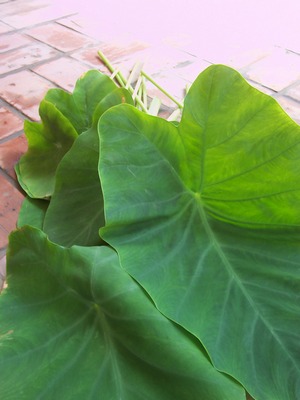
This Cuisine or recipe requires a leafy vegetable called Arbi patta in hindi and taro leaves or colocasia leaves in english. It looks like one in the above pic. It is a long greeny leafy vegetable which is then marinated and stuffed with paste and then rolled and cut into pieces and deep fried.


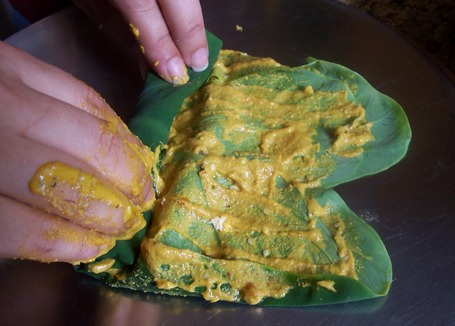
The masala paste which is prepared is stuffed in the leaf by spreading on it like the one in above pic. Then it is rolled (the way shown in pic) tightly and tied together and baked in steam . Later the baked stuff is cut and deep fried into bhajias.


Patra Bhajia is a well known and delicious cuisine from Gujrat. Patra bhajias are prepared in Maharashtra too, but known by the name of Aloo wadi. It is spicy and is tempting , one should definately try this out. The only difficult part is spreading or stuffing the paste but it too becomes easier if done carefully.
Ingredients:
15-20 large patra leaves (colocasia leaves)
1/2 cup tamarind extract (juice)
1 cup gramflour (besan)
3 tsp. chilli powder
1/2 tsp. turmeric powder
3-4 pinches asafoetida
1 tsp. crushed cumin seeds
3 tsp. powdered sugar
1 tbsp. oil
salt to taste.
For seasoning:
1 tbsp. oil
1/2 tsp. each cumin & mustard seeds
1 tsp. sesame seeds
1 tsbp. coriander leaves finely chopped
1 tbsp. coconut grated fine.
For deep fry:
Oil 3-4 cups.
Method:
  1. Clean, wash and wipe leaves. Cut thick veins with a pair of scissors.
  2. Roll lightly with a rolling pin. Keep aside.
  3. Mix all ingredients (not those for seasoning).
  4. The mixture should be a thick paste.
  5. Place a leaf backside up on a flat work surface.
  6. Take a little paste and apply thinly all over leaf surface.
  7. Place another leaf over it. Repeat.
  8. Get a set of 3-4 layered leaves, top layer being that of paste.
  9. Fold in the edges and roll the leaves, starting with their base towards tip.
  10. Make the roll tight and seal sides with some paste.
  11. Place in the perforated vessel of a double boiler or steam cooker.
  12. Repeat for all the leaves and paste.
  13. Steam in the cooker for 30-40 minutes till cooked.
  14. Cool, and remove. Cut into 1/2" thick slices.
  15. When cooled well, season as follows.
  16. Heat oil, add seeds, allow to splutter.
  17. Add sesame, coriander, and coconut.
  18. Check and adjust, salt, chilli and sugar as desired.
  19. Mix well, serve hot or cold.

Making Time: 40 minutes.

Serves: 24-26 patras approximately.

Shelflife: Seasoned 1 day and if deep fried 2-3 days.

Note: The patras can also be deep friend once its steamed and cut into pieces. It taste even more delicious when fried.
Click here to know more about Gujrati foods and cuisines- An Introduction To gujrati cuisines and Recipes.


●๋•∂нαηαѕняєє●๋•
A Kutch delicacy, Khaman dhokla is a salty steamed cake made from chickpea flour. Khaman Dhokla is a famous recipe from the state of Gujrat. Dhoklas are different from Khaman dhoklas. Khaman dhoklas are yellow in colour and made from besan or chickpea flour which is fermented with soda and baked. While dhoklas are prepared from rice n urad dal and is white in colour. Khaman dhoklas are tastier and delicious than dhoklas and are soft as sponge.


Ingredients:
Besan (Chickpea Flour) -2 cups
Turmeric powder - a pinch
Citric acid - 1 tsp (dissolved in 1/2 cup of water)
Sugar - 2tsp
Ginger garlic paste -1tsp
Water - 1 1/4cup
Soda - 1/2 tsp
Eno - 1 tsp (Lemon flavour preferably or fruit salt).

For Tempering:
1/2 tsp of mustard seeds
1/2 tsp of sesame seeds
2 green chillies Chopped
A pinch of Asafoetida
1tbsp of oil.

For Garnishing:
1tbsp of grated coconut
1tbsp of chopped coriander leaves.


Method:
  1. Mix all the ingredients except eno and citric acid till light and fluffy.
  2. Leave it for 20 minutes.
  3. Grease a flat plan with a little oil.
  4. Boil 2 glasses of water in a pressure cooker.
  5. Add the eno and citric acid to batter prepared.
  6. This will form a thick batter.
  7. Pour this batter into the greased pan or tray.
  8. Keep this tray into the cooker with lid on it.
  9. Steam for 15-25 minutes till a knife inserted comes out clean without stickiness.
  10. Do not keep the weights on cooker. Remove them before steaming the batter.
  11. To prepare the tempering, heat the oil in a small pan and add the mustard seeds. When they crackle add the sesame seeds, green chillies and Asafoetida and remove from fire.
  12. Add 1 tbsp of water to this tempering and pour over the steamed dhoklas.
  13. Garnish with grated coconut and chopped coriander leaves.
  14. Cut the dhoklas into small pieces and serve with green chutney.


Making Time: 30 minutes.

Serves: 4 persons

Shelflife: Best fresh.

Note: Instead of eno, dissolve citric acid and 1tsp sugar in 1 cup of water. Pour this along with seasoning over the dhokla. Also Stir the batter in one direction for a spongy final effect.

Click here to know more about Gujrati foods and cuisines-

An Introduction To gujrati cuisines and Recipes.

●๋•∂нαηαѕняєє●๋•

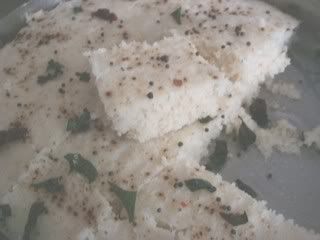
Dhokla is a baked dish from Gujrat. It looks soft as sponge and tastes delicious. Usually it is taken as snack and is served along with green chutney also called as coriander chutney or mint chutney. It is baked after fermentation and this initial preparation needs to be done carefully. There are different versions of dhokla, I am here giving the original and age old method of preparing dhokla. People often get confussed between Dhokla and Khaman Dhokla. Khaman dhokla is yellow in colour and is prepared from besan while Dhoka is white in colour and is prepared by grinding together rice and lentsil.


Ingredients:
1 cup rice
1 cup urad dal
1 cup yellow moong dal
3 cups sour buttermilk
2 green chillies crushed fine
1/4 tsp - ginger grated fine
1/2 tsp - soda bicarb
2 tbsp - oil
2-3 pinches red chilli powder
1/2 tbsp - coriander finely chopped
Salt To Taste .

For Tempering:
1/2 tsp mustard seeds
1/2 tsp sesame seeds
2 green chillies chopped or red chillies.
a pinch of asafoetida
1 tbsp of oil.

For Garnishing:
1 tbsp grated coconut
1tbsp chopped coriander leaves.


Method:


  1. Mix the rice and dal, wash, drain and dry on a clean cloth for a few hours.
  2. The grain should be completely. Grind to a coarse flour in dry grinder or at the flour mill. This flour should be like very fine soji in texture.
  3. Store in airtight container and use as required. Will keep good upto 2 months. To make , take 1 cup flour in a bowl.
  4. Add buttermilk, and mix well. Keep- aside for 4-5 hours.
  5. Dissolve sodabicarb in the oil. Add to batter.
  6. Mix all ingredients except red chilli powder and coriander. Pour immediately in a 6" diam. greased plate.
  7. Steam over water either in a cooker or steamer for some 15-16 minutes.
  8. Pierce knife, and check, should come out clean if done.
  9. Sprinkle the chilli powder and coriander, steam again for 2-3 minutes.
  10. Heat the oil for seasoning in a pan. Toss in the mustard seeds and fry till they splutter. Add green chillies and allow to spluter. Add Asafoetida to it.
  11. Add the sesame seeds and fry briefly till they are light brown and aromatic. Pour this over the steamed dhoklas.
  12. Ganish with lots of coriander and grated dry coconut.
  13. Cut into pieces and serve hot with any tangy chutney or just tomato sauce.


Making Time: 20 minutes.

Serves: 4-5 persons.

Shelflife: 1 day( best fresh).


Note: While stirring the batter, do take care to stir along one direction only. By stirring the batter in one direction , the dhokla batter fermentes nicely and the final result is spongy and delicious.


Click here to know more about Gujrati foods and cuisines- An Introduction To gujrati cuisines and Recipes.


●๋•∂нαηαѕняєє●๋•

Traditional Khandvi (in Gujarati) or Surali Chya Vadya (in Marathi) is a famous Western Indian dish. It is similar to rolled pasta made from chickpea flour. It is savoured as a snack or as a starter and is extremely popular in Gujarat and Northwestern Maharashtra.


Ingredients :
½ cup: Chick-pea flour
½ cup: Sour yogurt
½ tsp: Ginger paste
½ tsp: Green chilli paste
½ tsp: Chilli powder
1/8 tsp: Asafoetida
1/8 tsp: Turmeric
½ tsp: Mustard seeds
2 Sabut lal mirch
2 tsp: Oil
1 tsp: Salt or to taste
1 ½ cup: Water.

For seasoning:
2 tsp oil
1 tsp sesame seeds
1\2 tsp mustard seeds
1 tbsp coconut scraped
1 tbsp coriander finely chopped
2 pinches asafoetida
2 green chillies finely chopped
1 stalk curry leaves.


Method:
  1. Mix besan, turmeric powder, salt and hing to form a powdered batter.
  2. Now pour butter milk into the batter while stirring.
  3. Keep this batter on medium flame for 7-8 minutes and stir continuously, to avoid any lump formation.
  4. Cook till the mixture does not taste raw smell leaves, stirring continuously.
  5. When done (about 7 - 8 minutes), pour a ladleful in a large plate.
  6. Spread as thin as possible with the back of a large flat spoon.
  7. Use circular outward movements as for dosas.
  8. Let it cool. Afterwards, cut the spread into 2-inch wide strips and roll each strip carefully.
  9. Heat the oil. Add mustard seeds, curry leaves, sesame seeds and green chillies to it.
  10. Allow the seeds to crackle. Spread it immediately on the rolls.
  11. Khandavi is ready to serve.
  12. Garnish with grated coconut and chopped coriander leaves.

Making Time: 30 minutes.

Serves: makes 15-18 rolls.

Shelflife: 1 day.

Note: While cooking keep stirring continuously to avoid forming of lumps.

Click here to know more about Gujrati foods and cuisines- An Introduction To gujrati cuisines and Recipes.


●๋•∂нαηαѕняєє●๋•

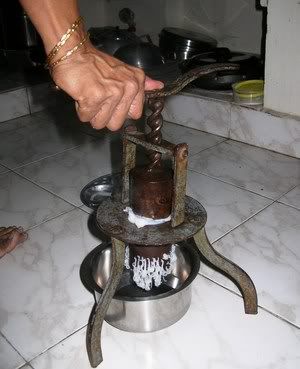
Major requirement of this recipe is the Sevai press or the Idiappam mould; If this is not available, readymade dry rice noodles (Indian) can be used. Ready-made rice noodles just require boiling and straining the noodles. The sevai press looks like the above one shown in pic.
It contains a bowl where the idlis are placed and the upper crust is used to press them into noodles.


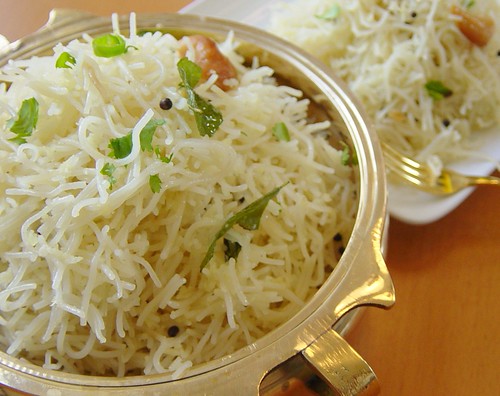
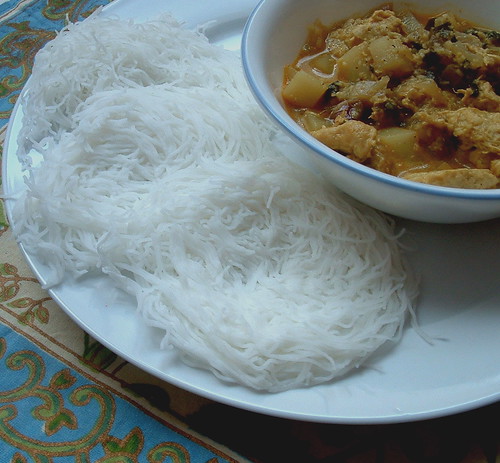
Many know about chinese noodles. But there are indian noodles too which are tastier and healthier than chinese ones. This one comes from South India; Called Sevai In Tamil or Shavige in Kannada, it is thinner than the ordinary chinese noodle. Also popularly known as Idiappam, these Indian rice noodles come both in sweet as well as spicy flavors. Traditonally it is prepared with Idiappam moulds, but Major Indian food brands like MTR bring out dry rice noodle packets which make your job easier. The soft and thin Idiappams,in its charming white color,when garnished with fresh grated coconut is a real beauty.Idiappam is said to be the best,when served with sweet coconut milk.


Ingredients:
1 cup ordinary rice
1 cup parboiled rice
2 tbsp. oil
salt to taste
water.


For Tempering:
Oil - 2 tsp
Dry red chilles- 4-5 nos. or green chillies -4-5 nos.
Mustard seeds - 1 tsp
Grated coconut - 4-5 tbsp.
Coriander leaves- 4 tbsp (optional).

Method:
  1. Wash and soak rice together overnight. Grind together to a fine paste. Keep aside for 5-6 hours.
  2. Put into idli moulds and steam till cooked.
  3. Grease a sev press. Place warm idli in it and press.
  4. Press out sev in a 4″ circle. See that ends overlap.
  5. Allow to cool a bit. Use greased palms and lift.
  6. Place in a double walled colander or steamer to keep warm.
  7. Cool, break unevenly.
  8. Heat oil in a pan, add finely chopped chillies and mustard seeds, fry till tender, add sev, salt, grated coconut, and mix. Garnish with coriander leaves if needed
  9. Serve warm or cold.

Making Time: 40 minutes.
Serves: 3 persons.
Shelflife:
1 day (best fresh).


Note: Optionally sun dry the idiappams till dry and crisp. Store and fry or steam when desired. Will keep for a few weeks in dry form. Enjoy it with coconut milk and sugar or with shredded coconut and sugar or with any curry. For added taste, Top with powdered sugar and ghee while serving.


Click here to know all about Tamil Nadu cuisines- Introduction To Tamil Nadu Cuisines And Recipes.


Blog Widget by LinkWithin
FSIS Post Divider Pictures, Images and Photos