 Tandoori Aloo is a "Tandoori platter" . The word tandoori is the adjective meaning "pertaining to the tandoor" and is used to describe a dish cooked in a tandoor. In India, the tandoor is also known by the name of bhatti. This dish is part of ‘Tandoori Platter’ , which consists of these Tandoori aloo, tandoori paneer, veg seekh kabab, dal makhani, naan, lots of onions , and green chutney. Tandoor is a hindi word which means cooked in oven. Most people seem to think that tandoori is a recipe. Like many of the world’s great dishes this is actually a cooking method that has become synonymous with the food that is prepared. Put simply tandoori is a marinated meat cooked over an intense fire in a tandoor. A tandoor is a clay oven in which a hot fire is build. Marinated meats are lowered into the oven on long metal skewers and cooked in this smoky and extremely hot environment until done.Typically a tandoor is dug into the ground or built into an enclosure. The real secret is that heat can only escape it through to top. The direct heat of the fire is reflected by the ceramic sides intensifying the heat and creating a cooking environment that easily reaches 500 degrees F. It is buried or enclosed to hold in the heat and to keep anyone from coming in contact with the outside surface.The marinade used in most any tandoori dish starts with yogurt. As for the spices, tandoori is marinated or rubbed with a great combination of spices. The first thing you will notice is the color. Tandoori dishes are usually very red or very yellow; this depends on the marinade ingredients.In addition to the colors provided by the spices, tandoori is also flavored traditionally with ginger, garlic, coriander powder, cayenne pepper, and garam masala.
The tandoor is used for cooking in Turkey, Pakistan, Afghanistan, the Transcaucasus, the Balkans, the Middle East, Central Asia as well as India and Bangladesh. You would be surprised to learn , Tandoor type materials were even found in Harappa and Mohen-ja-daro ruins.
The heat for a tandoor was traditionally generated by a charcoal fire or wood fire, burning within the tandoor itself, thus exposing the food to both live-fire, radiant heat cooking, and hot-air, convection cooking. Tandoor is very popular fixture in popular indian restaurants.
Tandoori Aloo is one such recipe and its a punjabi dish. Its a tasty and spicy food which would make one go drool over it.
Ingredients:250 grams baby potatoes (10-12)
1 tablespoon Red chilli powder
1 tablespoon Coriander powder
1 tablespoon Cumin powder
A pinch of Asafoetida
1 inch piece of ginger
8-10 garlic cloves
1/4 tablespoon of Ajwain (Carrom seeds)
1 teaspoon chat masala
1/4 teaspoon Turmeric powder
Salt to taste
3 tablespoons of Oil
1 tablespoon Chopped Coriander leaves for garnishing.
Method:- Choose only Baby potatoes for this recipe. Since it not only looks good but also tastes better and easy to cook as far as this recipe is concerned.
- Wash the potatoes properly and let them dry.
- Pierce the potatoes 2-3 times with fork. Pierce the potatoes at different parts but 2-3 times. This allows the pototoes to cook from inside too and allows the masala to penetrate inside.
- Arrange all the potatoes around the bowl on the microwave plate. If you have microwave without glass plate, place the bowl of water in a microwave-safe serving plate and potatoes around it. Those who dont have Ovens, can bake the potatoes in cooker .
- Cook the potatoes for 5-6 minutes or until they are soft and cooked.
- Now let the pototoes to cool.
- Meanwhile grind the rest of the masala powders (rest of the ingredients) to a fine paste in a blender by adding 2-3 tablespoons of water.
- Now heat the oil in a microwave for 1 minute on high. You can also use stove, just use a kadai and heat the oil.
- Meanwhile cut the potatoes into halves.
- Mix paste into the oil in a big bowl and heat for 30-40 seconds.
- Stir and add potatoes into the bowl and cook 2-3 minutes.
- If you are using stove, then cook it a kadai on low flame with closed lid for 3-4 minutes.
- Remove and garnish with Coriander leaves. You can also garnish with grated cheese for added taste.
- Serve hot with Tandoori roti or a side dish to jeera rice.
Preparation time: 20 minutes
Cooking time: 20 minutes
Serves: 4 persons
Shelflife: 1 day.
Serving suggestion: Serve hot with Tandoori roti or Jeera rice or a platter.
Note:- Choose only baby potatoes for making the dish intresting.
- Grind all the masalas to fine paste.
- IF not oven , then use a normal stove.
Click here to know more about Punjabi Foods and Cuisines -
An Introduction To Punjabi Foods And Cuisines.
 Huge varieties of chillies ( mirchi) are found in Rajasthan. An eight inch long variety is split open and filled with potato and masala and fried in besan to make this yummy vadas.This recipe needs chillies which are long , less spicy and bigger in size. So choose the chillies like the one above, which is light green, long and little bigger than normal chillies available in market.
India id known for for spicy foods. Thus chillies are must in every indian recipe. Chillies are used not used for adding spiceness to food but it is also used as main ingredients in many recipes. Mirchi vadas are one such popular snack from eastern regions of Rajasthan and Maharashtra. But it is widely prepared in Rajasthan. The main ingredient Mirchi should be choosen correctly for this recipe. There are varieties of chillies available in market. So the chilli which is not spicy should be choosen . Choose the one which is long like banana and is bigger is size, those chillies are not much spicy and it is perfect for making the vadas owing to it size and other features (see the above pic for chilli, the top one).
Ingredients:Long Banana size chillies -6 nos
For Batter:Gram flour - 1 cup
Turmeric powder (haldi) -2 pinches.
Salt to taste
Water as required.
For Filling:Potatoes - 3 large ones
Red chilli powder - 1 tbsp
Coriander leaves chopped fine - 1/2 tbsp
Salt to taste.
Method:- Slit the peppers, remove seeds and keep aside.
- Boil potatoes with salt.
- Peel and mash them well.
- Add chilly powder and coriander leaves. Mix well.
- Make a thick batter with the flour, turmeric powder and salt.
- Fill the chillies with the potato mix.
- Dip the filled peppers in the batter till they are completely covered.
- Fry them in preheated oil till golden brown.
- Serve hot with chutney or sauce.
Making Time: 20 minutes
Serves: 4 persons
Shelflife: Best Fresh.
Note:- Deep fried snacks contains lots of oil, so always transfer them on a absorbent paper before transfering to plates when u take them from oil.
- If you prefer spicy, then you can keep the seeds while u silt.
Click here to know more about Rajasthani foods and cuisines - Introduction to Rajasthani Foods And Cuisines.
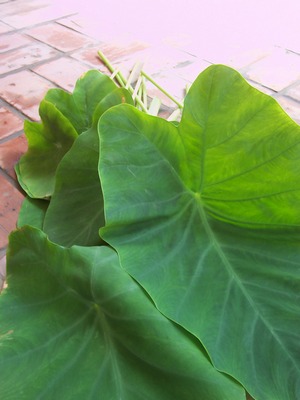
 This Cuisine or recipe requires a leafy vegetable called Arbi patta in hindi and taro leaves or colocasia leaves in english. It looks like one in the above pic. It is a long greeny leafy vegetable which is then marinated and stuffed with paste and then rolled and cut into pieces and deep fried.
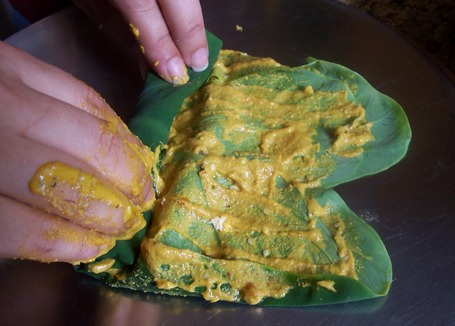
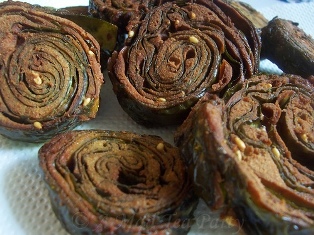
 The masala paste which is prepared is stuffed in the leaf by spreading on it like the one in above pic. Then it is rolled (the way shown in pic) tightly and tied together and baked in steam . Later the baked stuff is cut and deep fried into bhajias.
 Patra Bhajia is a well known and delicious cuisine from Gujrat. Patra bhajias are prepared in Maharashtra too, but known by the name of Aloo wadi. It is spicy and is tempting , one should definately try this out. The only difficult part is spreading or stuffing the paste but it too becomes easier if done carefully.
Ingredients:
15-20 large patra leaves (colocasia leaves)
1/2 cup tamarind extract (juice)
1 cup gramflour (besan)
3 tsp. chilli powder
1/2 tsp. turmeric powder
3-4 pinches asafoetida
1 tsp. crushed cumin seeds
3 tsp. powdered sugar
1 tbsp. oil
salt to taste.
For seasoning:
1 tbsp. oil
1/2 tsp. each cumin & mustard seeds
1 tsp. sesame seeds
1 tsbp. coriander leaves finely chopped
1 tbsp. coconut grated fine.
For deep fry:
Oil 3-4 cups.
Method:
- Clean, wash and wipe leaves. Cut thick veins with a pair of scissors.
- Roll lightly with a rolling pin. Keep aside.
- Mix all ingredients (not those for seasoning).
- The mixture should be a thick paste.
- Place a leaf backside up on a flat work surface.
- Take a little paste and apply thinly all over leaf surface.
- Place another leaf over it. Repeat.
- Get a set of 3-4 layered leaves, top layer being that of paste.
- Fold in the edges and roll the leaves, starting with their base towards tip.
- Make the roll tight and seal sides with some paste.
- Place in the perforated vessel of a double boiler or steam cooker.
- Repeat for all the leaves and paste.
- Steam in the cooker for 30-40 minutes till cooked.
- Cool, and remove. Cut into 1/2" thick slices.
- When cooled well, season as follows.
- Heat oil, add seeds, allow to splutter.
- Add sesame, coriander, and coconut.
- Check and adjust, salt, chilli and sugar as desired.
- Mix well, serve hot or cold.
Making Time: 40 minutes.
Serves: 24-26 patras approximately.
Shelflife: Seasoned 1 day and if deep fried 2-3 days.
Note: The patras can also be deep friend once its steamed and cut into pieces. It taste even more delicious when fried.
 Ingredients:
3 onions cut in strips
1 1/2 cup gram flour
1 tbsp. rice flour
6-7 green chillies finely chopped
1 tbsp. coriander leaves finely chopped
2 tbsp. hot oil
salt to taste
oil to deep fry.
Method:- Sprinkle salt over onion in a wide bowl.
- Keep aside for 15-20 minutes.
- Add all other ingredients and mix well.
- Do not add more water.
- The water given out while onion marinated is enough.
- Mix well, heat oil.
- Drop gently small lumps of mixture in hot oil.
- Deep fry on med. heat till golden brown.
- Drain on kitchen paper to remove excess oil.
- Serve hot with chutney or ketchup.
Making time:30 minutes
Makes: 18-20 bhajjies
Shelflife:Best fresh .
Note: Always serve this hot and fresh. It looses its crispness after some time.
Click here to know about Maharashtrian food and Recipes- Introduction To Maharashtrian Cuisine.







 Posts
Posts


